

If you searched something like "UNC acceptance rate" or "UNC out-of-state acceptance rate," you were most likely looking for UNC-Chapel Hill's undergraduate admissions numbers, not the MBA program at the Kenan-Flagler Business School. Both are real, useful questions — they are just entirely different admissions offices, applicant pools, and processes. Below is the undergraduate answer first, followed by a full guide to Kenan-Flagler MBA admissions for anyone applying to the business school.
UNC-Chapel Hill Undergraduate Acceptance Rate (Quick Answer)
UNC-Chapel Hill's overall undergraduate acceptance rate was approximately 15.3% for the Class of 2028, the most recent cycle with published final numbers — 66,535 applicants and 10,209 admitted (Ivy Coach, citing UNC data; corroborated by The Koppelman Group and UNC's own admissions data page). Residency changes the picture dramatically because North Carolina law caps non-resident enrollment at 18% of each incoming class:
- In-state acceptance rate: ~37.9% (6,289 admitted of 16,553 in-state applicants), per The Koppelman Group.
- Out-of-state acceptance rate: ~6.6%–8.1% (2,792–3,413 admitted of roughly 42,000 out-of-state applicants), per The Koppelman Group and the UNC admissions data page.
UNC's own admissions site reports 73,192 total applicants and 5,624 enrolling students (first-year plus transfer) for the fall 2024 entering class, but does not itself publish a headline acceptance-rate percentage on that page (admissions.unc.edu). None of this applies to Kenan-Flagler MBA admissions, which is a separate, much smaller applicant pool reviewed by a completely different admissions committee — the rest of this guide covers that program in full.
Is the UNC acceptance rate the same as the Kenan-Flagler MBA acceptance rate? No. UNC-Chapel Hill's undergraduate acceptance rate (~15.3% overall, ~38% in-state, ~7-8% out-of-state) describes first-year college admissions. Kenan-Flagler's MBA acceptance rate is a separate figure for graduate business school applicants — and unlike the undergraduate numbers, it is not officially published at all (see below).
UNC Kenan-Flagler MBA: What the School Is Looking For
Kenan-Flagler explicitly seeks "bright, motivated students who aspire to make a positive impact in the business world," typically with an average of five years of work experience, though the school "encourages all competitive applicants to apply" regardless of experience level (Kenan-Flagler Requirements and Deadlines). No prerequisite courses are required, but the school expects a working knowledge of financial accounting, statistics, economics, and calculus. Admissions review uses multiple independent readers — three to five people may review a single file. One reader evaluates the applicant "blind" to test scores or waiver status to get a sense of them as a person; a separate interviewer reviews essays, transcripts, and the résumé; and a full-file reader weighs everything together, including recommenders and any red flags, sometimes with input from a Career & Leadership staff member on fit with stated goals (UNC Kenan-Flagler Admissions Director interview). The 2026-2027 essay prompts lean hard into culture fit with the school's four core values — impact, innovation, inclusion, and integrity — signaling that community contribution matters as much as résumé strength (Clear Admit's UNC essay analysis).
UNC Kenan-Flagler MBA Acceptance Rate — The Honest Answer
Here is the fact this guide has to be blunt about: UNC Kenan-Flagler does not publish an official MBA acceptance rate, applications total, or yield for the Full-Time MBA. Its official class-profile and admissions pages report class size and score/GPA data, but not the acceptance funnel itself (Kenan-Flagler Class Profile). Any specific acceptance-rate percentage you see quoted online is a third-party estimate, not a school-confirmed figure.
Those third-party estimates cluster in a fairly narrow band, which is useful context even though it is unofficial: Poets&Quants' school profile cites 38% for the Class of 2025, with 495 students across the two-year program (Poets&Quants school profile); Target Test Prep cites "third-party estimates around 36-37%" for the Class of 2027 (Target Test Prep); Leland cites 38% with 2,064 applications and 249 enrolled for the Class of 2026 (Leland); and Stacy Blackman Consulting cites 2,224 applicants and 249 entering students, also for the Class of 2026 (Stacy Blackman Consulting). Because these figures diverge slightly and none trace back to an official Kenan-Flagler disclosure, treat ~35-38% as a reasonable third-party estimate range, not a confirmed number.
The Full-Time MBA is not the only format. MBA@UNC, Kenan-Flagler's online MBA, is a genuinely confusing case: reported acceptance rates conflict across sources and cycles, ranging roughly from 49% to 62%. The school's own data submission to US News shows the highest and most recent citable figure — 868 applicants, 542 accepted, for a 62% acceptance rate (US News). Poets&Quants has separately reported 56% for one recent cohort (Poets&Quants MBA@UNC profile), and earlier historical data from the same publication shows admit rates of 49% and 53% for two prior classes (Poets&Quants, "Acceptance Rates (& Yield) At Top Online MBA Programs"), while Fortune reported 57% for 2020 (Fortune Education). Kenan-Flagler itself does not publish a single fixed acceptance rate for MBA@UNC on either kenan-flagler.unc.edu or onlinemba.unc.edu — the 49%–62% range reflects real conflict across sources and years, not a typo, and 62% (school-reported to US News) and 56% (Poets&Quants) are the two most recent citable figures.
What is the UNC Kenan-Flagler MBA acceptance rate? Kenan-Flagler does not officially publish one. Third-party estimates for the Full-Time MBA run roughly 35-38% (Poets&Quants, Target Test Prep, Leland, Stacy Blackman Consulting). For the online MBA@UNC program, reported figures conflict across sources and cycles from 49% to 62%, with 62% from the school's own US News data submission and 56% from Poets&Quants as the two most recent numbers. Treat any single percentage as an estimate, not an official statistic.
UNC Kenan-Flagler Full-Time MBA Class Profile (Class of 2027)
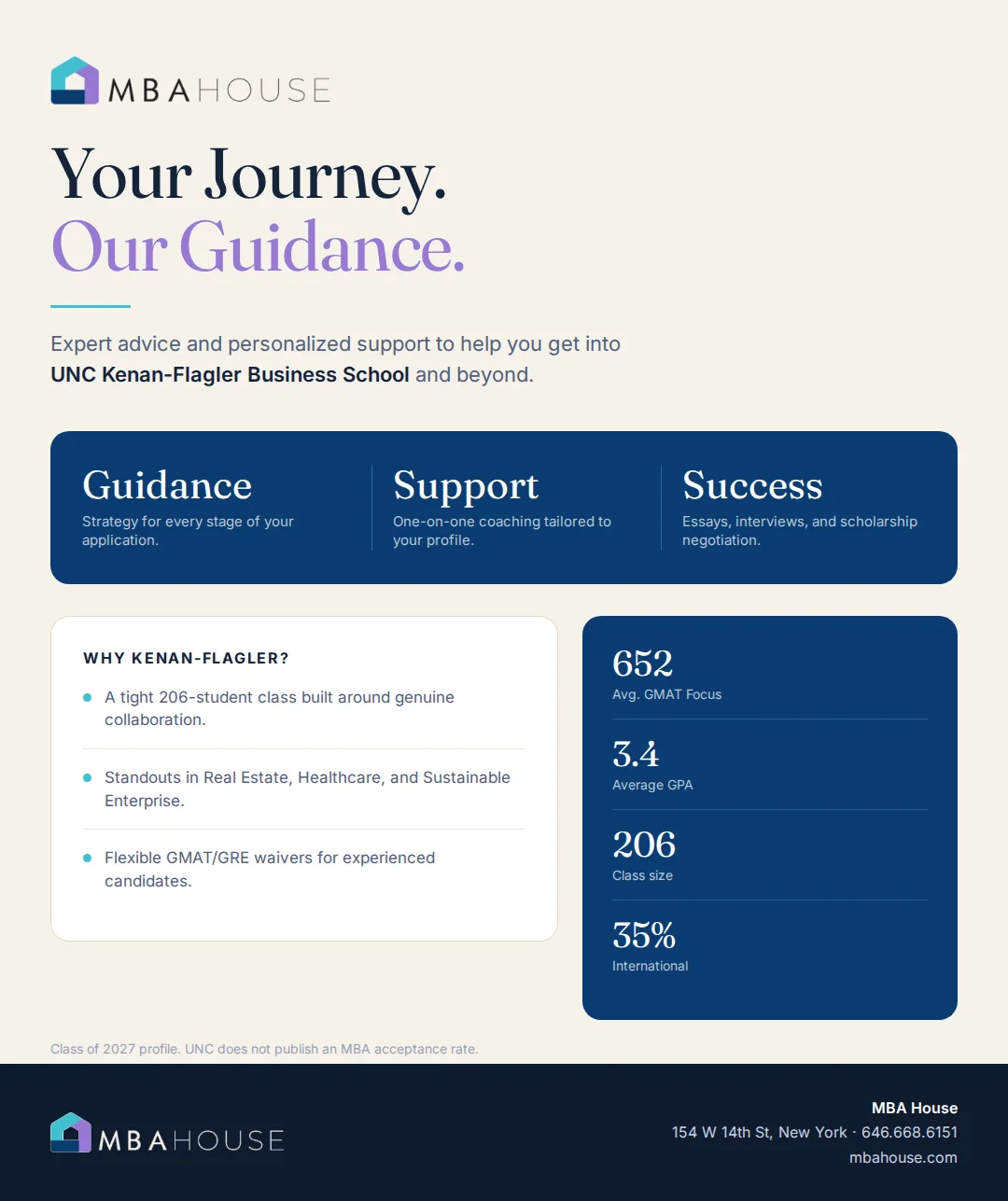
Unlike the acceptance rate, the class profile is officially published and detailed. Per the Kenan-Flagler Class Profile, the Class of 2027 looks like this:
| Metric | Class of 2027 |
|---|---|
| Class size | 206 |
| Average age | 28 |
| Average work experience | 5 years |
| Average GPA | 3.4 (middle 80%: 2.9–3.9) |
| Average GMAT Focus score | 652 (middle 80%: 605–715) |
| Average GRE | 319 (middle 80%: 304–332) |
| Women | 32% |
| International | 35% (65% domestic) |
| Military | 15% |
| Dual-degree students | 10% |
| Countries represented | 18 |
| Undergrad major mix | Business/econ 46%, STEM 39%, arts/humanities 4%, other 9% |
Two notes on scope. First, the official class-profile page now reports GMAT Focus Edition scores only; it does not state an old-scale (pre-2024) GMAT average for the current class. Secondary and historical sources report old-scale averages of 696 (Class of 2025) and 707 (Class of 2026) (GMAT Club; Stacy Blackman Consulting), but these describe prior cohorts, not the Class of 2027, and are not official current-year conversions. Second, the current class-profile page does not state a U.S. minority percentage; a prior-year secondary source cites approximately 26% for the Class of 2025 (Admit Expert), but this figure is unconfirmed for the current class and should be treated as an estimate, not a current statistic.
GMAT, GRE, and Test Waivers at Kenan-Flagler
Kenan-Flagler is explicitly flexible on standardized testing and runs a formal waiver process. To submit a Full-Time MBA application, a candidate must provide either a valid GMAT/GRE score or an approved waiver (Kenan-Flagler GMAT/GRE Waiver FAQ). Waiver requests require a waiver statement, an up-to-date résumé, unofficial transcripts, and completed Personal/Education application tabs. Waiver eligibility criteria — any one of which can support a case, evaluated holistically rather than automatically — include: a 3.2+ undergraduate GPA with STEM, business, economics, or otherwise analytical coursework from a U.S. institution; an advanced or terminal degree (JD, MD, PhD, or a STEM/business/economics master's); five-plus years of professional experience in a quantitative or analytical field; a CFA or U.S. CPA credential; or strong scores on the Executive Assessment, PCAT, or MCAT (Kenan-Flagler GMAT/GRE Waiver FAQ; corroborated by Kenan-Flagler's waiver info page). The school states plainly: "you will not be at a disadvantage for admission if you are approved for a standardized test waiver," though admissions staff may still suggest testing to strengthen recruiting competitiveness. Waivers must be requested fresh each cycle, are format-specific (a Full-Time MBA waiver cannot cover Executive MBA or online applications), and are unavailable to anyone who has already submitted a score.
MBA@UNC is even more permissive: GMAT/GRE is not required for applicants with five-plus years of full-time professional experience (onlinemba.unc.edu). Applicants with fewer than five years must submit a score but can still request a waiver by demonstrating quantitative strength. In one recent incoming online-MBA class, 86% of admits got in without a GMAT or GRE score at all, reflecting both the program's longer average work experience and the school's own internal research finding the GMAT "a poor predictor of performance" for candidates with significant work history (Poets&Quants). Executive MBA applicants (Evening, Weekend, and Charlotte formats) are not required to submit a GMAT or GRE score at all given the seniority of the applicant pool, though a separate EMBA waiver form exists for anyone who wants formal confirmation (Weekend Executive MBA FAQs).
What GMAT score do you need for UNC Kenan-Flagler? The Class of 2027 average GMAT Focus score is 652, with a middle 80% range of 605–715. The average GRE is 319 (middle 80%: 304–332). There is a formal waiver process, and the school states waived applicants face no admissions disadvantage.
UNC Kenan-Flagler MBA Application Deadlines
Kenan-Flagler runs four rounds for the Full-Time MBA. The dates below are the official planned deadlines for the 2026-2027 cycle (Class of 2029, fall 2027 start); the application was described as not yet open as of this writing, so always confirm against the official Kenan-Flagler Requirements and Deadlines page before finalizing your plan.
| Round | Submission deadline | Waiver deadline | Decision released | Deposit deadline |
|---|---|---|---|---|
| Round 1 | September 30, 2026 | September 9, 2026 | December 9, 2026 | February 10, 2027 |
| Round 2 | January 6, 2027 | December 9, 2026 | March 10, 2027 | April 14, 2027 |
| Round 3 (final, international) | March 3, 2027 | February 10, 2027 | April 21, 2027 | May 12, 2027 |
| Round 4 | April 21, 2027 | April 7, 2027 | May 19, 2027 | June 9, 2027 |
All deadlines are 11:59 p.m. ET, and Round 3 is the final round open to international applicants, since visa and relocation timelines need more runway. Consortium applicants follow a separate track: an early deadline of October 15, 2025 and a Round 2 deadline of January 5, 2026. The non-refundable enrollment deposit is $1,500 regardless of round. MBA@UNC runs four start dates a year — January, April, July, and October — with its own priority and final deadlines; for example, the October 2026 start has a priority deadline of June 22, 2026 and a final deadline of July 20, 2026, while the January 2027 start has a priority deadline of October 12, 2026 and a final deadline of November 9, 2026 (MBA@UNC Admissions). Starting January 2026, all new MBA@UNC students must attend an in-person Orientation and a Summit within their first year, both required for graduation.
The Kenan-Flagler MBA Application — Essays, Recommendations, Interview
Essays (2026-2027 Cycle)
Per Clear Admit's official-prompt analysis, the current Full-Time MBA essay set is compact and values-driven (Clear Admit UNC Essay Analysis):
| Essay | Prompt focus | Word limit |
|---|---|---|
| Essay 1 (required) | Your MBA goals or the path you're considering, and how they reflect your unique background | 250 words |
| Essay 2 (required) | Which of the four core values — impact, innovation, inclusion, integrity — resonates most with your professional journey, with an example | 250 words |
| Optional essay | Anything else that helps the committee know you as a person | 200 words |
| Re-applicant essay (re-applicants only) | How this application differs from your previous one | 100 words |
The heavy emphasis on the four core values is the clearest strategic signal in the whole application: Kenan-Flagler is explicitly screening for culture fit and community contribution, not just résumé strength. An essay that only lists accomplishments without connecting them to impact, innovation, inclusion, or integrity misses the point of the prompt.
Recommendations and Interview
Two letters of recommendation are required (Leland, citing the official checklist); re-applicants must submit new recommenders alongside new essays and an updated résumé. Interviews are by invitation only, extended any time after a complete application is submitted, up until the decision-release date — there is no fixed interview-notification window (Kenan-Flagler Interviews & Visits). Interviews run about 30 minutes, have a conversational tone, and are conducted by a member of the Admissions Team who has already reviewed the file. Candidates can interview in person or virtually by webcam, and the admissions committee states no preference between formats. Other required items include transcripts, résumé, a GMAT/GRE score or approved waiver, and a $150 application fee (waivers available for some candidates); MBA@UNC additionally requires English-proficiency scores for non-native English speakers unless exempted.
The four-core-values essay prompt rewards applicants who can connect a specific story to impact, innovation, inclusion, or integrity — not just list achievements. An MBA House application audit pressure-tests that narrative before you submit.
UNC Kenan-Flagler MBA Cost of Attendance (2026-2027)
Cost varies sharply by residency, which matters for North Carolina applicants weighing in-state options. Per the official Kenan-Flagler Tuition & Financial Aid page:
| Expense category | North Carolina residents | Non-residents |
|---|---|---|
| Tuition and mandatory fees (per year) | $55,470 | $74,192 |
| Total annual cost incl. living expenses | ~$84,890 | ~$103,612 |
Mandatory fees include a $345 orientation fee and $1,030 in MBA Student Association dues. The living-expense component is itemized at roughly $29,420 per year: housing $13,788, food $6,702, health insurance $3,606, miscellaneous $3,100, travel $1,488, books $474, and a direct loan fee of $262. Tuition is described as likely to increase 3-10% per academic year and is finalized each summer pending state budget approval, so always verify the current figure before committing to a financing plan. A secondary source (mbaschools.org), citing prior-year figures, reports slightly lower tuition of $55,416 (in-state) / $74,138 (out-of-state) and estimated annual cost of attendance around $84,238 (in-state) / $102,960 (out-of-state), implying a two-year total of roughly $168,000–$206,000 depending on residency (mbaschools.org) — treat this as a prior-year estimate, not the current official number shown above.
For MBA@UNC, Kenan-Flagler's own tuition page does not display a single headline total-cost figure (onlinemba.unc.edu Tuition & Financial Aid). Secondary sources — mbaschools.org and Poets&Quants — both report a total program cost of approximately $125,589 for the 2025-2026 cohort, with a flexible program length of 18 to 36 (up to 60) months and, notably, no residency differential (mbaschools.org; Poets&Quants MBA@UNC profile).
How much does the UNC Kenan-Flagler MBA cost? For 2026-2027, tuition and mandatory fees are $55,470/year for North Carolina residents and $74,192/year for non-residents. Total annual cost of attendance including living expenses is approximately $84,890 (in-state) or $103,612 (out-of-state), per the official tuition page.
Scholarships and Fellowships
Per the official Kenan-Flagler Full-Time MBA Fellowships page, nearly 50% of Full-Time MBA students receive some form of merit-based fellowship, and the admissions application doubles as the fellowship application — there is no separate form. Premier Fellowships, the most prestigious tier, cover full tuition and fees plus a $5,000 stipend and inclusion in a fellows-only résumé guide. Full Tuition Fellowships cover tuition and fees for students of any citizenship based on academic distinction, work experience, and other qualities. Partial-Tuition Fellowships are awarded on academic achievement and, often, specific career goals, and MBA Veterans Scholarships help cover non-tuition costs like housing, books, and computers. Fellowships run for the full two-year program, contingent on maintaining eligibility, and no new fellowship awards are made in the second year (Kenan-Flagler international-student financial aid PDF). For MBA@UNC, a limited number of partial-tuition fellowships are awarded automatically to every applicant with no separate application, though the number and amount vary each year; online students are not eligible for the University of North Carolina System Tuition Waiver Program (onlinemba.unc.edu Tuition & Financial Aid). If you are weighing scholarship strategy across schools, our broader guide to getting MBA scholarships covers how a competitive test score can function as leverage at merit-aid programs like this one.
UNC Kenan-Flagler MBA Employment Outcomes (Class of 2025)
Per the official employment statistics page and Class of 2025 one-pager (Kenan-Flagler Employment Facts & Figures; Class of 2025 Employment Statistics One-Pager):
| Metric | Class of 2025 |
|---|---|
| Job offers and accepts, 3 months post-graduation | 88% |
| Job accepts, 6 months post-graduation | 90% |
| Offers/accepts, students with U.S. work authorization | 91% |
| Offers/accepts, students without U.S. work authorization | 81% |
| Average (mean) base salary | $139,637 |
| Average (mean) signing bonus | $32,558 |
| Jobs accepted outside the U.S. | 4% |
Note that Kenan-Flagler's official one-pager reports mean, not median, base salary and signing bonus for the Class of 2025 — median figures are not stated. For context, the prior year (Class of 2024) reported a mean base salary of $140,490, a mean signing bonus of $33,422, and 85% of students receiving a signing bonus (Class of 2024 Employment Statistics One-Pager).
By industry, the Class of 2025 landed heaviest in Financial Services and Consulting, both at a median salary of $175,000:
| Industry | % of students | Median salary |
|---|---|---|
| Financial Services | 25% | $175,000 |
| Consulting | 18% | $175,000 |
| Healthcare (products & services) | 14% | $132,000 |
| Technology | 13% | $142,000 |
| Energy | 8% | $128,000 |
| Real Estate | 8% | $125,000 |
| Consumer Packaged Goods | 5% | $128,000 |
| Retail | 3% | $130,000 |
By function, Finance took the largest single share of the class at 40%, with Investment Banking alone accounting for 15% of the class at a $175,000 median, followed by Consulting (17%, $175,000 median) and General Management (15%, $130,000 median) (Class of 2025 Employment Statistics One-Pager). The school states more than 280 employers hire Kenan-Flagler MBA students each year, with more than 100 companies visiting campus to recruit, though a specific ranked "top employers" list for the Class of 2025 was not published — the school instead posts historical employer lists rather than a ranked top-N table.
What is the average salary after a UNC Kenan-Flagler MBA? The Class of 2025 reported a mean base salary of $139,637 and a mean signing bonus of $32,558. Financial Services and Consulting were the two largest industries, both with a $175,000 median salary. Median (as opposed to mean) base salary was not published for this class.
What Kenan-Flagler Is Known For
Kenan-Flagler's academic identity centers on a few signature strengths, most of them grounded in experiential learning rather than pure classroom theory. STAR (Student Teams Achieving Results) is the flagship: a roughly 30-year-old program pairing 5-7 member teams of MBA and undergraduate students as informal consultants to real companies, with past partners including NASCAR, Procter & Gamble, Hershey, Nike, Google, ESPN, GE, and Panera Bread (Kenan-Flagler STAR Program). It is widely cited by Poets&Quants as the program's most distinctive offering and a major reason it is associated with hands-on leadership development.
Real estate is another marquee area — one of the largest MBA real estate concentrations in the country, historically drawing 8-10% of each class, with coursework spanning construction, development, finance, and fund/property management; U.S. News ranks Kenan-Flagler among the top dozen programs for real estate. Healthcare is a similarly strong concentration, leveraging UNC's top-ranked School of Medicine and School of Public Health along with the Research Triangle Park life-sciences corridor. Kenan-Flagler was also among the first U.S. business schools to build dedicated coursework, research, and an MBA concentration around sustainable enterprise, historically recognized by Bloomberg Businessweek's "Best Green MBA" and Financial Times' corporate-responsibility rankings. Consulting is consistently one of the top two post-MBA industries alongside financial services (18-21% of the class in recent years), and Fortune ranked the program #5 for consulting in 2025. Overall, the program offers 13 concentrations plus a Family Enterprise focus area, and is STEM-designated across all MBA formats (Kenan-Flagler Concentrations & Electives).
Other UNC Kenan-Flagler MBA Formats
Kenan-Flagler runs several MBA formats beyond the Full-Time program, each with a distinct applicant profile. The Evening Executive MBA targets professionals with an average of 9 years of work experience over a 24-month program starting each September; GMAT/GRE is not required, and the Executive Assessment may be used instead. The Weekend Executive MBA is a small-cohort program (roughly 50 students per class) for more senior professionals: per the official Class of 2027 snapshot, the average age is 38 (range 29-58), average work experience is 15 years (range 5-34), 41% of the cohort is women, and it draws from 37 companies across 11 states (Weekend Executive MBA overview). Minimum experience is 5 years (8 preferred), and GMAT/GRE is not required. The Charlotte Executive MBA averages 10 years of work experience over a 24-month program with weekly classes in Charlotte; per an October 2024 exit survey, participants saw an average salary increase of 18% during the program, with starting salaries ranging $67,000-$450,000 and ending salaries $87,000-$515,000 (Charlotte Executive MBA Career & Leadership). Detailed class-size, GMAT/GPA, and acceptance-rate data for the Evening, Weekend, and Charlotte formats are not published on the pages reviewed for this guide — treat any specific figures you see for these formats elsewhere as unconfirmed.
MBA@UNC, the online MBA, reports 31% female, 23% minority, 30% military students, an average of 10 years of work experience, students from 24 non-U.S. countries, and 20% holding another advanced degree, per the school's own admissions page (onlinemba.unc.edu Admissions). A separate Poets&Quants data set for a specific cohort shows some divergence — average GMAT 677, average GPA 3.10, average GRE 310, 1.8% international, 25.9% U.S. minority, 29% female — which likely reflects a different year or cohort rather than an error; both are cited here rather than reconciled, since neither source is dated identically (Poets&Quants MBA@UNC profile).
Choosing between the Full-Time, Executive, and online MBA@UNC formats depends on your work experience, timeline, and goals — and the essay strategy differs for each. Book a free strategy call and we'll help you pick the right format and build the application plan around it.
Do You Need an MBA Admissions Consultant for Kenan-Flagler?
With an estimated Full-Time MBA acceptance rate in the mid-30s percent range — an unofficial but consistent estimate across multiple sources — Kenan-Flagler is competitive but not in Harvard or Stanford territory, which changes the calculus on outside help. The differentiator at the margin is less about a flawless test score (the school explicitly offers waivers) and more about a coherent narrative that speaks directly to the four core values driving the essay prompts, plus a résumé and recommender strategy that holds up across three to five independent readers. A good admissions consultant provides essay coaching, positioning strategy, and interview preparation before submission — exactly when there is still time to fix a generic or scattered narrative. New York-based applicants have access to specialized MBA admissions consulting through MBA House; if you are unsure whether the investment makes sense for your profile, our honest breakdown of whether you need an MBA admissions consultant is a good starting point, and you can always begin with a no-cost conversation.
The Bottom Line on UNC Kenan-Flagler MBA Admissions
Two things are true at once about Kenan-Flagler. First, if you came here searching for "UNC acceptance rate," the number you likely wanted is the undergraduate rate — approximately 15.3% overall, ~38% in-state, ~7-8% out-of-state — and it has nothing to do with the MBA program. Second, if you are actually applying to the Kenan-Flagler MBA, the honest picture is that the school does not publish an official acceptance rate at all; the best available context is a cluster of third-party estimates around 35-38% for the Full-Time MBA and a genuinely conflicting 49-62% range for the online MBA@UNC program. What is fully documented, by contrast, is everything that actually determines your outcome: a Class of 2027 profile centered on a 652 average GMAT Focus score and 3.4 average GPA, a formal test-waiver process, a compact two-essay application built around four core values, four rounds of deadlines, real fellowship money reaching nearly half the class, and strong outcomes in finance, consulting, real estate, and healthcare. Build your application around those documented realities, not around an acceptance-rate number the school itself has never confirmed.
If you want a candid read on how your GMAT/GRE plan, essay narrative, and recommender strategy stack up for Kenan-Flagler — or for any MBA program you're weighing it against — book a free strategy call and we will build the plan with you.
Ready to pressure-test your UNC Kenan-Flagler application? Book a free strategy call for a candid assessment of your profile, a realistic score and timeline plan, and the specific moves that will strengthen your candidacy.
UNC Kenan-Flagler MBA Admissions FAQs
What is UNC-Chapel Hill's undergraduate acceptance rate?
UNC-Chapel Hill's overall undergraduate acceptance rate was approximately 15.3% for the Class of 2028 (66,535 applicants, 10,209 admitted), per Ivy Coach's analysis of UNC data. This is the undergraduate rate, not the Kenan-Flagler MBA rate — they are entirely separate admissions processes.
What is UNC's acceptance rate for out-of-state students?
UNC's out-of-state undergraduate acceptance rate is roughly 6.6%–8.1% (2,792–3,413 admitted of about 42,000 out-of-state applicants), per The Koppelman Group's analysis. This low rate is driven by a North Carolina state law capping non-resident enrollment at 18% of each incoming class.
What is UNC's in-state acceptance rate?
UNC's in-state undergraduate acceptance rate is approximately 37.9% (6,289 admitted of 16,553 in-state applicants), per The Koppelman Group. In-state applicants are admitted at roughly five times the rate of out-of-state applicants.
What is the UNC Kenan-Flagler MBA acceptance rate?
UNC Kenan-Flagler does not publish an official MBA acceptance rate, applications count, or yield. Third-party estimates for the Full-Time MBA range from roughly 35% to 38%, per Poets&Quants, Target Test Prep, Leland, and Stacy Blackman Consulting, but none of these figures are confirmed on an official Kenan-Flagler page, so treat any specific percentage as an unverified estimate.
What is the MBA@UNC online MBA acceptance rate?
Reported figures for MBA@UNC, Kenan-Flagler's online MBA, conflict and range roughly from 49% to 62% depending on the cycle and source. The school's own US News data submission shows 62% (868 applicants, 542 accepted), while Poets&Quants has reported 56% for one cohort and 49%–53% for earlier classes. Kenan-Flagler does not publish a single official acceptance rate for MBA@UNC.
What GMAT score do you need for UNC Kenan-Flagler?
The Class of 2027 Full-Time MBA average GMAT Focus score is 652, with a middle 80% range of 605–715, per the official Kenan-Flagler class profile. The average GRE is 319 (middle 80%: 304–332). Kenan-Flagler also offers a formal test waiver, so a strong score is not mandatory for every applicant.
What GPA do you need for UNC Kenan-Flagler MBA?
The Class of 2027 average undergraduate GPA is 3.4, with a middle 80% range of 2.9–3.9, per the official Kenan-Flagler class profile. There is no stated minimum, and admissions review is holistic.
What are the UNC Kenan-Flagler MBA application deadlines?
For the Class of 2029 cycle, Round 1 closes September 30, 2026, Round 2 closes January 6, 2027, Round 3 (final for international applicants) closes March 3, 2027, and Round 4 closes April 21, 2027, all at 11:59 p.m. ET, per the official Kenan-Flagler requirements and deadlines page.
Does UNC Kenan-Flagler require the GMAT or GRE?
Not always. Applicants must submit either a GMAT/GRE score or an approved waiver. Waiver eligibility includes a 3.2+ undergraduate GPA in quantitative coursework, an advanced degree (JD, MD, PhD, or STEM/business master's), five-plus years of professional experience in an analytical field, a CFA or CPA credential, or strong Executive Assessment, PCAT, or MCAT scores, per the official GMAT/GRE Waiver FAQ. Kenan-Flagler states applicants are not disadvantaged for using an approved waiver.
How much does the UNC Kenan-Flagler MBA cost?
For the 2026-2027 academic year, tuition and mandatory fees are $55,470 per year for North Carolina residents and $74,192 per year for non-residents. Total annual cost of attendance including living expenses is approximately $84,890 (in-state) or $103,612 (out-of-state), per the official Kenan-Flagler tuition and financial aid page.
Does UNC Kenan-Flagler offer MBA scholarships?
Yes. Nearly 50% of Full-Time MBA students receive some form of merit-based fellowship, and the admissions application doubles as the fellowship application with no separate form required, per the official Kenan-Flagler fellowships page. The top tier, Premier Fellowships, covers full tuition and fees plus a $5,000 stipend.
What is the average salary after a UNC Kenan-Flagler MBA?
The Class of 2025 reported an average (mean) base salary of $139,637 and an average signing bonus of $32,558, per the official Class of 2025 Employment Statistics one-pager. By industry, Financial Services and Consulting led at a median of $175,000 each.
What is UNC Kenan-Flagler's STAR program?
STAR (Student Teams Achieving Results) is Kenan-Flagler's roughly 30-year-old flagship experiential learning program, pairing 5-7 member teams of MBA and undergraduate students as informal consultants to real companies such as NASCAR, Nike, Google, and Procter & Gamble, per the official STAR program page. It is widely cited as the school's most distinctive offering.
Is UNC Kenan-Flagler good for real estate or healthcare MBA concentrations?
Yes. Kenan-Flagler has one of the largest MBA real estate concentrations in the country, historically drawing 8-10% of each class, and a strong healthcare concentration that leverages UNC's medical and public health schools and the Research Triangle Park life-sciences corridor, per the official curriculum and concentrations pages.
Do I need an MBA admissions consultant to get into UNC Kenan-Flagler?
No, a consultant is not required. But with an estimated acceptance rate in the mid-30s percent and an admissions process that uses multiple independent readers evaluating essays, fit with the school's four core values, and full-file context, positioning and essay strategy matter enormously at the margin. A good consultant provides outside perspective on your narrative and essays before you submit, when there is still time to fix weak spots.