

Getting into the Wharton School is often misunderstood as easier than Harvard or Stanford because of one number: the Wharton MBA acceptance rate, which third-party estimates put well above its two closest peers. That framing is dangerous. Wharton does not publish an official acceptance rate anywhere on its site — a fact worth stating plainly before any number is quoted — and the estimates that do circulate (18.6% to 21%, depending on the cycle) still describe one of the most competitive graduate programs in the world. What actually separates admits from the rest of the pool is not a lower bar; it is a different bar, built around Wharton's stated emphasis on analytical rigor combined with team collaboration (see The Wharton Way).
This guide walks through every component of a strong Wharton application using current, source-attributed data: the full Class of 2027 profile, average GMAT and GRE scores, the essays, the distinctive Team-Based Discussion interview, application deadlines, fellowships, true cost of attendance, employment outcomes, and how Wharton compares with Harvard and Stanford GSB. MBA House — known to New York applicants as GMATNY — has spent years helping candidates build applications that hold up under Wharton's collaborative, analytically minded review. If you want to pressure-test your own profile, you can book a free strategy call at any point.
Wharton MBA Acceptance Rate — What the Numbers Actually Say
Start with the fact Wharton itself states: the official Wharton MBA Class Profile reports application and enrollment counts but never an admit count or an acceptance rate. Any "Wharton acceptance rate" you see quoted is therefore a third-party estimate, not a Wharton-published statistic — and because the underlying admit counts are not public, different secondary sources land on different numbers depending on their methodology and the cycle they are reporting.
With that caveat clearly stated: U.S. News reports Wharton's acceptance rate at approximately 18.6% for its most recent ranked cycle (2026 U.S. News Best Business Schools), a figure cited by GMAC's summary of U.S. News data and by a GMAT Strategy blog analysis of the same rankings. Other admissions-consultancy sources have cited a range of 20.5%-21% for the Class of 2026 based on U.S. News data reported a year earlier, including Stacy Blackman Consulting and Admit Beacon. The honest summary: treat the Wharton MBA acceptance rate as somewhere in the high teens to low twenties, sourced to U.S. News rather than to Wharton, and expect it to move a point or two year to year as application volume shifts.
This same figure is sometimes searched as the "UPenn MBA acceptance rate," since Wharton is the University of Pennsylvania's business school — the two terms describe the identical program and the identical estimate range.
Applications, Class Size, and Yield
For the Class of 2027 (enrolled Fall 2025), Wharton received 7,613 applications and enrolled 888 students, according to the official Wharton MBA Class Profile, corroborated by Poets&Quants. The prior class, Class of 2026, had 7,322 applications and 866 enrolled per the same Wharton source (Wharton's Career Management office separately reports 874 total enrolled for its Class of 2025/2026 career-report tables — a modest discrepancy between two primary Wharton sources that likely reflects different measurement dates). Wharton's yield rate is not published on any official page; unverified forum estimates of roughly 60-62% exist but are not corroborated by a primary or trusted secondary source, so this guide does not report a yield figure as fact.
What is the Wharton acceptance rate? Wharton does not officially publish an acceptance rate. U.S. News reports it at approximately 18.6% for the most recent ranked cycle, while other secondary sources have cited 20.5%-21% in earlier cycles. Both figures come from U.S. News data via third parties, not from Wharton itself, so treat any number you see as an estimate.
Wharton Class Profile — Class of 2027
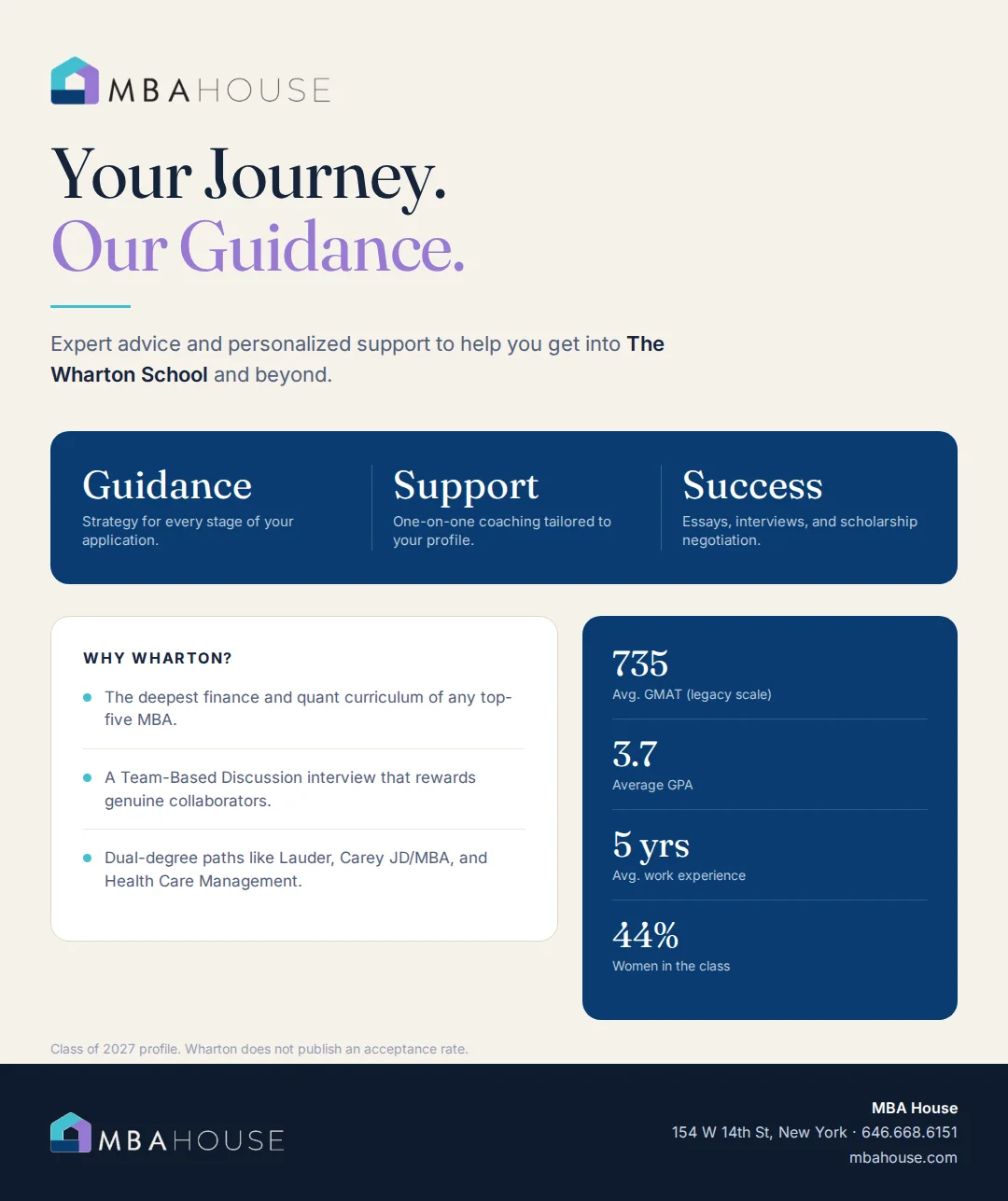
The Wharton MBA Class Profile is the single best source for understanding who actually gets in. The Class of 2027 is 44% women and 26% international, drawn from 68 countries, with 11% first-generation students and 6% U.S. military veterans (Poets&Quants). Academically, undergraduate majors split fairly evenly across Humanities (36%), STEM (32%), and Business (32%), and 82% of the class attended a U.S. undergraduate institution versus 18% non-U.S.
| Metric | Class of 2027 | Class of 2026 |
|---|---|---|
| Applications | 7,613 | 7,322 |
| Class size (enrolled) | 888 | 866 |
| Average GMAT (legacy scale) | 735 | 732 |
| Average GMAT Focus Edition | 676 | Not separately reported |
| Average GRE Verbal / Quant | 162 / 163 | 163 / 162 |
| Average undergraduate GPA | 3.7 | 3.68 |
| Average work experience | 5 years | 5 years |
| % Women | 44% | 47% |
| % International | 26% | 31% |
| Countries represented | 68 | 65 |
Sources: Wharton MBA Class Profile; Poets&Quants Class of 2027 analysis; GMAC's Wharton class profile summary.
The top pre-MBA feeder industries for the Class of 2027 were Consulting (31%), Private Equity/VC (15%), Nonprofit/Government (10%), Investment Banking (8%), Technology (8%), Health Care (4%), and Investment Management (4%), per Poets&Quants. Wharton also enrolls a meaningful cohort of students in interdisciplinary programs: 72 in the Lauder MBA/MA, 72 in the MBA in Health Care Management, 12 in the Carey JD/MBA, and 54 in the Moelis Advance Access deferred-admission cohort, alongside 675 in the standard two-year MBA.
One important note on class averages: Wharton's current Class Profile page does not display a middle-80% GMAT range for the Class of 2027 — only the class average — a change from older profiles like the Class of 2017, which did show a range (see the archived Class Profile). Wharton's official FAQ also states explicitly that there is no minimum or maximum years-of-work-experience requirement, actively welcoming candidates with 0-3 years of experience alongside more seasoned applicants (Wharton MBA Admissions FAQ).
Wharton Average GMAT and GRE Scores
Test scores at Wharton are read as one signal of academic readiness inside a genuinely holistic process — the school states plainly that there is no minimum GMAT or GRE score to apply, and no preference for one test over the other (Wharton MBA Class Profile).
Wharton Average GMAT (Legacy and Focus Edition)
For the Class of 2027, Wharton's average GMAT on the legacy (10th Edition) scale was 735, up slightly from 732 for the Class of 2026, according to Poets&Quants and confirmed by GMAC. Separately, Wharton's average GMAT Focus Edition score for the Class of 2027 was 676. Because the Focus Edition uses a different 205-805 scale from the legacy 200-800 exam, these two averages are not directly comparable — do not treat 676 as "lower" than 735 in any meaningful sense; they measure different populations on different scales. If you are still learning how the current exam works, our guide to what the GMAT Focus is breaks down the sections and scoring in detail.
Wharton Average GRE Scores
The Class of 2027 average GRE score was 162 Verbal and 163 Quantitative, per GMAC's reporting on Wharton's class profile — close to the Class of 2026 average of 163 Verbal / 162 Quant. As with the GMAT, there is no stated preference between the GRE and GMAT, so choose based on your own strengths. Official registration and prep materials are available through ETS GRE for business school.
Wharton MBA GMAT Waiver — Does Wharton Offer One?
No. Wharton's own official Q&A is unambiguous: "Wharton does not offer waivers for the GMAT (Graduate Management Admission Test) or GRE (Graduate Record Examination). One exam is required as part of the application. There is no preference between the two" (Wharton School — "Inbox Confessionals"). This is corroborated by the official Wharton MBA Application Guide, which states that all applicants must submit either exam. So if you are searching for a Wharton MBA GMAT waiver, the answer is that none exists — every applicant sits one of the two tests, with no exceptions for years of experience or prior degrees. The one waiver Wharton does offer is unrelated: an English-language proficiency waiver (TOEFL/PTE/IELTS/Duolingo) for applicants who studied in English or have at least four years in an English-speaking professional environment, requested with an explanation in the application.
What is Wharton's average GMAT? The Class of 2027 average GMAT on the legacy scale was 735; the average GMAT Focus Edition score was 676. There is no minimum score and no test waiver — every applicant must submit a GMAT or GRE score, with no stated preference between them.
Wharton MBA Application Deadlines (2026-2027)
Wharton is one of the few M7 schools that still runs a full three-round process, plus a separate deferred-admissions track. The deadlines below are for the 2026-2027 cycle; always confirm against the official Wharton MBA Application Timeline & Deadlines page, since all times are Eastern and cutoffs are strict.
| Round | Application deadline | Decision released |
|---|---|---|
| Round 1 | September 8, 2026 (5:00 PM ET) | December 17, 2026 |
| Round 2 | January 5, 2027 (5:00 PM ET) | March 31, 2027 |
| Round 3 | March 31, 2027 (5:00 PM ET) | May 11, 2027 |
| Deferred Admissions (Moelis) | April 21, 2027 (11:59 PM ET) | July 1, 2027 |
Applications submitted after the Round 1 or Round 2 deadline roll automatically into the next round, and applications after the Round 3 deadline are not accepted. The Carey JD/MBA and Lauder MBA/MA programs accept applications in Rounds 1 and 2 only. Wharton's own guidance notes that first-time applicants, reapplicants, and international students managing visa timing are encouraged to apply in Round 1 or 2, since Round 3 is more competitive with limited remaining seats (Wharton Application Timeline).
The Wharton MBA Application — Essays, Recommendations, Résumé
Wharton's application is built around a distinctive evaluation framework: every application is read independently by two admissions readers with no knowledge of each other's assessment, judged against three questions about what you will contribute to the Wharton classroom, the Wharton community, and your post-MBA career (Wharton MBA Application Guide).
Wharton MBA Essays (2026-2027)
| Essay | Prompt | Word limit |
|---|---|---|
| Essay 1a | What is your immediate post-MBA professional goal? | 50 words |
| Essay 1b | Describe your medium- and long-term professional goals after your Wharton MBA. | 150 words |
| Essay 2 | Taking into consideration your background, how do you plan to add meaningful value to the Wharton community? | 350 words |
| Reapplicant essay (if applicable) | How have you reflected and grown since your previous application? | 250 words |
| Additional Information (optional) | Any information not found elsewhere, including extenuating circumstances | 500 words |
All prompts and word limits are quoted directly from the official Wharton MBA Application Guide. The two-part goals question (Essay 1a/1b) rewards precision — vague answers like "consulting or finance" waste scarce words that should instead name specific industries, functions, or problems. Essay 2's "meaningful value" prompt is where Wharton's collaborative, analytically minded culture matters most: strong answers connect a specific personal, professional, or academic background to a concrete way you will contribute inside Wharton's classroom and clubs, not just a restated résumé.
Letters of Recommendation
Wharton requires one letter of recommendation, ideally from a current or former supervisor well acquainted with your performance in a work setting, submitted through the GMAC Common Letter of Recommendation (Wharton MBA Application Guide). This is notably leaner than Harvard's two-letter requirement, which raises the stakes on the single recommender you choose — pick someone who can speak to specific, recent examples of your impact rather than someone chosen for seniority alone. The one exception is the Carey JD/MBA program, which requires two letters.
Résumé and Application Fee
Wharton requires a one-page résumé (PDF, max 10MB) plus transcripts from every undergraduate and graduate program attended. The application fee is $275, non-refundable ($100 for Moelis Advance Access applicants), with fee waivers available for U.S. military active-duty and veteran applicants, and for Moelis applicants demonstrating financial hardship (Wharton MBA Application Guide).
Wharton's single recommendation letter and short, pointed essays leave little room for a weak link. An MBA House application audit pressure-tests your essay strategy, recommender choice, and TBD readiness before you submit.
The Wharton Team-Based Discussion — What to Expect
Wharton's interview format is genuinely unlike any other top program's. Rather than a one-on-one conversation, admitted-track applicants are invited to a Team-Based Discussion (TBD): a 35-minute virtual group exercise with 5-6 fellow applicants, assigned to random groups and given a prompt to work through together toward a tangible outcome (Wharton MBA Interview Process). Interviews are by invitation only, and no candidate is admitted without one.
Immediately following the group exercise, each candidate completes a 10-minute one-on-one interview with a member of the admissions team, reflecting on their TBD performance. Wharton explains that the format is designed to model "the highly collaborative nature of the Wharton MBA environment," assessing communication style, level of engagement, leadership skills, and decision-making process in a live team setting rather than a scripted individual Q&A. Interdisciplinary applicants — Lauder, Carey JD/MBA, and Health Care Management — complete a second, program-specific interview in addition to the standard TBD.
The practical implication for preparation is different from a traditional interview: rehearsing answers to "tell me about a time you led a team" matters less than practicing how you actually behave inside a live group under time pressure — do you listen, build on others' ideas, and help the group reach a decision, or do you talk over people and chase your own agenda? Mock TBD sessions with peers are the single highest-leverage way to prepare.
What is the Wharton Team-Based Discussion? A 35-minute virtual group exercise with 5-6 fellow applicants working toward a shared outcome, followed by a 10-minute individual interview. It replaces the one-on-one interview format used at Harvard and Stanford and is designed to assess collaboration and leadership in a live team setting.
Wharton MBA Tuition and Cost of Attendance (2026-2027)
The honest cost of a Wharton MBA extends well beyond the tuition line. Here is Wharton's official 2026-2027 cost of attendance for a single student, with First Year and Second Year budgets presented identically by the school.
| Expense category | Annual cost (2026-2027) |
|---|---|
| Tuition | $87,970 |
| University fees | $5,038 |
| Total tuition & fees | $93,008 |
| Housing | $21,258 |
| Food | $9,287 |
| Books and supplies | $1,123 |
| Transportation | $1,044 |
| Personal | $4,703 |
| Health insurance | $5,018 |
| Total living expenses | $42,433 |
| Total annual cost of attendance (single) | $135,441 |
| Two-year program total (sum of identical annual budgets) | ~$270,882 |
All figures are from the official Wharton MBA Financial Aid and Tuition page. Note that Wharton presents identical First Year and Second Year budgets rather than a single pre-computed two-year total, so the ~$270,882 figure is a straightforward sum of Wharton's own numbers, not a lump sum Wharton states directly. Lauder MBA/MA students should budget meaningfully more: an additional $14,500 in summer tuition, $16,200 in academic year fees across both years, and $13,176 in summer living expenses, bringing total Lauder-specific costs to roughly $179,317 in Year 1 and $151,641 in Year 2, per the same Wharton tuition page. For context on the prior year, a secondary source (Crack the MBA) cites a slightly lower 2025-2026 figure of $92,820 in tuition and fees — useful only to see the year-over-year increase, not as a current number.
What is Wharton MBA tuition? For 2026-2027, Wharton MBA tuition is $87,970 per year, with total tuition and fees of $93,008. Including housing, food, and living expenses, the full annual cost of attendance for a single student is $135,441, or roughly $270,882 across the two-year program.
Wharton MBA Fellowships and Financial Aid
Wharton's aid model differs meaningfully from Harvard's. Every admitted student is automatically considered for a Wharton Fellowship as part of the admissions review — no separate application is required. The Fellowship Committee makes its best offer at the time of admission based on academic achievement, professional accomplishments, personal background, and community involvement, and awards are final and not reconsidered. Wharton states plainly that it does not offer need-based fellowships, which makes its aid effectively merit-based — the opposite of Harvard's need-only model (Wharton School — "Inbox Confessionals").
Wharton-affiliated sources describe a range of named fellowships, including Joseph Wharton Fellowships, Howard E. Mitchell Fellowships (for underrepresented students of color, sometimes full-tuition), Forté Fellowships for women, the ROMBA LGBT+ Fellowship (minimum $20,000), and the full-tuition Wharton Prism Fellowship, documented on the official Wharton Alumni MBA Fellowship page. That same page describes endowed fellowship funding tiers ranging from roughly $25,000/year per $500,000 endowed up to about $150,000/year per $3,000,000 endowed. Anecdotal individual award reports commonly cited by students range from about $50,000 to $150,000 total, though Wharton does not publish an official award-size table, so treat that range as informal, not authoritative. If you are comparing how scholarship strategy differs by school, our guide to getting MBA scholarships covers when a strong test score becomes a real financial lever.
Wharton MBA Employment Outcomes (Class of 2025)
The most recent full-time employment data — the Class of 2025, reported via Wharton's own Career Management office — shows a record year for pay even as offer and acceptance rates ticked down slightly.
| Metric | Class of 2025 |
|---|---|
| Total students | 879 |
| Students seeking employment | 608 (69.2%) |
| % receiving job offers | 90.5% |
| % accepting job offers | 87.0% |
| Median base salary | $185,000 |
| Base salary 25th / 75th percentile | $165,000 / $192,000 |
| Median sign-on bonus | $30,000 |
| Median performance bonus (among reporting) | $25,357 |
Sources: Wharton MBA Career Management — Full-Time Jobs Overview and the official 2025 Career Report, corroborated by Clear Admit and Poets&Quants, both of which independently confirm the $185,000 median salary as a new school record. The median base of $185,000 applies only to the 69.2% of the class that actively sought traditional employment — it is not a class-wide average, and the share seeking traditional jobs and the offer/accept rates both dipped modestly versus the prior year even as pay rose.
Top Industries and Functions
| Industry | % of accepts | Median salary |
|---|---|---|
| Financial Services (all subcategories) | 38.2% | $175,000 |
| Consulting | 28.2% | $190,000 |
| Technology | 15.3% | $164,250 |
| Private Equity / Buyouts | 13.4% | $200,000 |
| Investment Banking / Brokerage | 14.2% | $175,000 |
| Health Care | 3.8% | $155,000 |
Consulting/Strategy was the single largest function at 31.4% of accepts (median $183,976), followed by Private Equity/Venture Capital investing roles at 13.0% (median $188,879) and Investment Banking at 13.0% (median $180,982), according to the 2025 Career Report. A total of 304 distinct employers hired students from the Class of 2025 (The Wharton School), with top recruiters including McKinsey, Bain, BCG, Goldman Sachs, J.P. Morgan, Morgan Stanley, Blackstone, Apollo Global Management, KKR, Amazon, Google, and Microsoft.
Wharton MBA vs. Harvard and Stanford GSB
Choosing between Wharton, Harvard, and Stanford is a question of fit, not just prestige. Here is an honest comparison across the dimensions that matter most to applicants.
| Dimension | Wharton | Harvard (HBS) | Stanford GSB |
|---|---|---|---|
| Class size (recent) | ~888 | ~943 | ~432 |
| Acceptance rate (third-party estimate) | ~18.6%-21% | ~11% | ~6-8% |
| Interview format | Team-Based Discussion (group) | One-on-one, invitation only | One-on-one, invitation only |
| Recommendation letters | 1 (2 for Carey JD/MBA) | 2 | Varies |
| Fellowship model | Automatic consideration, merit-oriented | Need-based only | Need-based, some merit |
| Best known for | Finance, analytics, quantitative rigor | General management, case method | Tech entrepreneurship, small cohort |
Wharton's own admissions FAQ pushes back on the stereotype that it is purely a finance school for quants: roughly 40% of the class comes from liberal arts backgrounds, and there is no minimum or maximum work-experience requirement (Wharton MBA Admissions FAQ). What genuinely differentiates Wharton is the Team-Based Discussion — a live test of collaboration that neither Harvard nor Stanford uses — and its deeper finance and analytics coursework relative to Harvard's broader general-management case-method brand. On the numbers, Wharton's estimated acceptance rate sits comfortably above both peers, but a higher estimated rate does not mean an easy admit: all three schools run genuinely holistic, highly competitive review, and Wharton's essays and TBD reward a different kind of preparation, not a lower bar.
Choosing between Wharton, Harvard, and Stanford — or building an application built specifically around Wharton's Team-Based Discussion — is exactly the kind of decision a structured outside review de-risks before you submit.
Common Wharton MBA Application Mistakes
- Treating the estimated acceptance rate as official. Wharton does not publish one; quoting 18.6% as a Wharton statistic rather than a U.S. News-sourced estimate is a factual error interviewers and adcoms notice.
- Writing essays with no team-collaboration signal. Wharton explicitly evaluates fit with its "highly collaborative and analytically focused environment" — essays that only showcase individual achievement miss the point.
- Preparing for the TBD like a normal interview. Rehearsed talking points do not help in a live group exercise; practice how you actually behave under time pressure with peers.
- Choosing a recommender by title over knowledge. With only one letter allowed, the choice is more consequential than at schools requiring two.
- Assuming a quant background is required. About 40% of the class has a liberal arts background; a well-told non-quant story is not a disadvantage.
- Ignoring the two-part goals essay's word limits. 50 words and 150 words leave no room for vague answers like "consulting or finance" — name specifics.
- Underestimating total cost of attendance. Budgeting only for the $87,970 tuition line and missing the $135,441 full annual cost leads to financing surprises.
The Bottom Line on Getting Into Wharton
Wharton's numerically higher estimated acceptance rate makes it feel more attainable than Harvard or Stanford on paper, but the substance of the review is every bit as rigorous — just built around a different signal set. The Team-Based Discussion tests how you actually behave in a room with peers, the single recommendation letter raises the stakes on your one choice, and the short essays reward precision about goals and genuine fit with a "highly collaborative and analytically focused environment," in Wharton's own words. Applicants who treat Wharton as a fallback or a numbers game consistently underperform against those who prepare specifically for its format.
That kind of targeted preparation is exactly what MBA House builds with applicants every cycle — connecting your GMAT or GRE plan, your essays, and dedicated Team-Based Discussion practice into one coherent strategy aimed at Wharton. If you want a candid read on where your profile stands today, book a free strategy call and we will build the plan with you.
Ready to pressure-test your Wharton application? Book a free strategy call for a candid assessment of your profile, a realistic GMAT/GRE and timeline plan, and dedicated Team-Based Discussion practice.
Wharton MBA Admissions FAQs
What is the Wharton MBA acceptance rate?
Wharton does not publish an official acceptance rate. U.S. News reports it at approximately 18.6% for its most recent ranked cycle, while other secondary sources have cited 20.5%-21% in earlier cycles. Treat any Wharton acceptance rate you see as a U.S. News-sourced estimate, not an official Wharton statistic.
What is the UPenn MBA acceptance rate at Wharton?
The Wharton MBA acceptance rate and the UPenn MBA acceptance rate refer to the same program, since Wharton is the University of Pennsylvania's business school. Wharton itself does not publish an admit count or acceptance rate; U.S. News-sourced estimates put it at roughly 18.6%-21% depending on the cycle.
What is Wharton's average GMAT score?
For the Class of 2027, Wharton's average GMAT (legacy 10th Edition scale) was 735, and the average GMAT Focus Edition score was 676. Wharton no longer publishes a middle-80% GMAT range on its current Class Profile page, only class averages. There is no minimum GMAT score to apply.
What is Wharton's average GMAT Focus score?
The Class of 2027 average GMAT Focus Edition score at Wharton was 676, according to GMAC's and Poets&Quants' reporting on Wharton's class profile release. This differs from the average legacy (10th Edition) GMAT of 735 because the two exams use different scales.
How much does Wharton MBA tuition cost?
For the 2026-2027 academic year, Wharton MBA tuition is $87,970 per year, with total tuition and fees of $93,008. Including housing, food, and other living expenses, Wharton's total annual cost of attendance for a single student is $135,441, or approximately $270,882 across the two-year program.
What is in the Wharton MBA class profile?
The Wharton Class of 2027 enrolled 888 students from 7,613 applications, is 44% women and 26% international, represents 68 countries, and has an average GMAT of 735 (676 GMAT Focus), average GRE of 162 Verbal/163 Quantitative, and an average GPA of 3.7. Top pre-MBA industries were consulting (31%), private equity/VC (15%), and nonprofit/government (10%).
Does Wharton offer a GMAT or GRE waiver?
No. Wharton's official FAQ states plainly that it does not offer waivers for the GMAT or GRE — one of the two exams is required of every applicant, with no preference between them. A separate English-language test waiver (TOEFL/PTE/IELTS/Duolingo) is available for eligible applicants, but that is not a GMAT/GRE waiver.
What are the Wharton MBA application deadlines for 2026-2027?
Round 1 closes September 8, 2026 (5:00 PM ET) with decisions December 17, 2026. Round 2 closes January 5, 2027 with decisions March 31, 2027. Round 3 closes March 31, 2027 with decisions May 11, 2027. Wharton is one of the few M7 schools that still runs a full Round 3.
What is the Wharton Team-Based Discussion?
The Team-Based Discussion (TBD) is Wharton's signature interview format: a 35-minute virtual group exercise with 5-6 fellow applicants working toward a shared outcome, followed by a 10-minute individual interview reflecting on your performance. It is designed to assess communication style, engagement, leadership, and decision-making in a team context, and it replaces the one-on-one interview format used at most peer schools.
How many letters of recommendation does Wharton require?
One letter of recommendation, ideally from a current or former supervisor who can speak to your performance in a work setting, submitted through the GMAC Common Letter of Recommendation. Carey JD/MBA applicants are the exception and must submit two letters.
Does Wharton offer merit scholarships?
Every admitted student is automatically considered for a Wharton Fellowship as part of the admissions review, based on academic achievement, professional accomplishments, personal background, and community involvement — no separate application is required. Wharton states it does not offer need-based fellowships, making its awards effectively merit-based, unlike Harvard's need-only model.
What is the average salary after a Wharton MBA?
The Class of 2025 reported a median base salary of $185,000, a new school record, with a median sign-on bonus of $30,000. Among the 69.2% of the class that sought employment, 90.5% received job offers and 87.0% accepted offers by the time of Wharton's official Career Report.
How does Wharton compare to Harvard and Stanford on acceptance rate?
None of the three schools publish an official acceptance rate, but third-party estimates suggest a clear ordering: Wharton is the most numerically accessible of the three at roughly 18.6%-21% (U.S. News-sourced), followed by Harvard Business School at approximately 11%, with Stanford GSB the most selective at around 6-8%. All three remain highly competitive holistic reviews, so a higher estimated rate at Wharton does not mean it is an easy admit.
Do I need a quant background to get into Wharton?
No. Despite its reputation for analytical rigor, Wharton's own admissions FAQ notes that roughly 40% of the class comes from liberal arts backgrounds, and there is no minimum or maximum years-of-work-experience requirement. Wharton actively welcomes early-career candidates alongside more seasoned applicants.
Do I need an MBA admissions consultant to get into Wharton?
No, a consultant is not required. But Wharton's distinctive Team-Based Discussion format and its short, high-stakes essays reward applicants who have rehearsed and pressure-tested their story in advance. A good consultant helps with essay strategy, TBD practice, and interview prep before you submit, when there is still time to fix weak spots.