

A score plateau describes the results, not their cause. This guide shows how to turn recent work into a practical error log, distinguish different failure points, and test whether a correction helps on unfamiliar questions.
The aim is not to explain away disappointing results. It is to replace “I need to work harder” with a specific decision about what to change, why to change it, and how to evaluate the next attempt.
Check whether your results are comparable
Before diagnosing a plateau, write down the conditions of your recent assessments. Note the source, interruptions, fatigue, use of assistance, and whether you recognized questions from earlier attempts.
Keep the section order and break choices in that record. The current GMAT allows you to choose the order of its three sections and take one optional ten-minute break after the first or second section. (Official GMAT exam structure)
Do not treat a repeated practice exam as identical evidence to an unfamiliar one. You may remember the answer, the structure, or the explanation even when you do not consciously recognize every detail.
Likewise, separate untimed exercises from timed assessments. They answer different questions about your preparation: whether you can reason through a task and whether that reasoning holds under the conditions you are testing.
If the conditions differ substantially, describe the result cautiously. A higher or lower number alone does not identify which part of your preparation changed.
Start by selecting a manageable sample of recent, reasonably comparable work. You need enough evidence to notice a repeated pattern, but you do not need to reconstruct every question you have ever attempted.
Look beyond the number of wrong answers
Two missed questions can have different causes. One may expose a concept you have not learned; another may show that you knew the concept but answered a different question from the one asked.
Include correct answers in your review when you guessed, changed methods repeatedly, or could not explain why the selected option was right. A correct choice is not automatically evidence of a reliable process.
Also record confidence. A confidently wrong answer may reveal a rule you have misunderstood, while a hesitant correct answer may reveal knowledge you have not yet learned to use independently.
Do not label every mistake “careless.” That word can hide several actionable problems: overlooking a restriction, copying a quantity incorrectly, confusing a percentage base, or failing to check what the question requested.
Try this prompt: “What would an observer have seen me do at the moment my approach went wrong?” An observable action is easier to change than a general judgment about your ability.
This review framework is a teaching tool, not an official GMAT scoring model. Use it to investigate your process rather than to predict a score from a count of error categories.
Build a practical GMAT error log
An error log should help you make decisions about future work. If it becomes a long archive of copied explanations that you never revisit, simplify it until every entry has a clear purpose.
The five fields below follow the framework in the visual. Keep entries short enough to use, but specific enough that you can understand them several days later without reopening the entire solution.
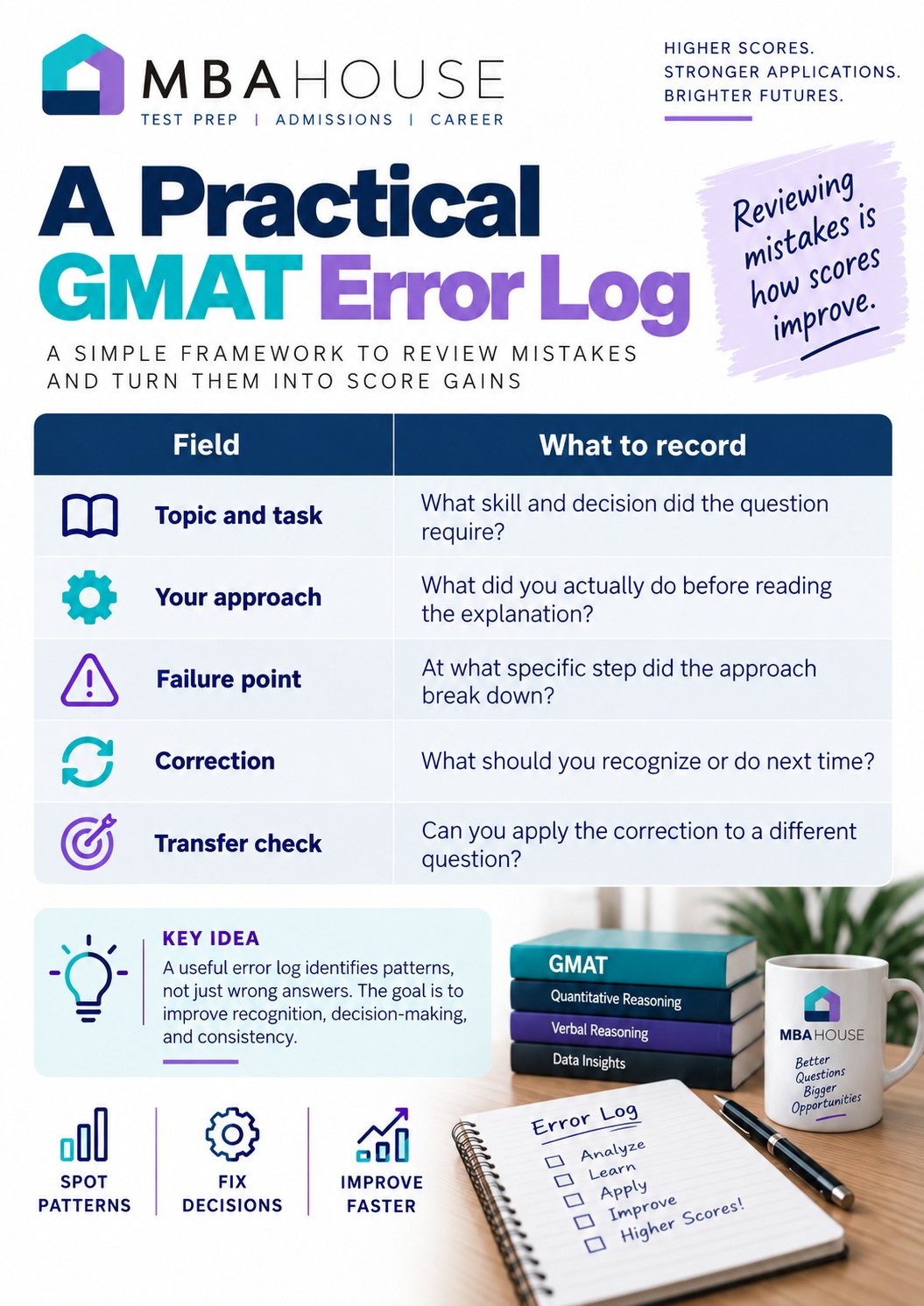
| Field | What to record |
|---|---|
| Topic and task | What skill and decision did the question require? |
| Your approach | What did you actually do before reading the explanation? |
| Failure point | At what specific step did the approach break down? |
| Correction | What should you recognize or do next time? |
| Transfer check | Can you apply the correction to a different question? |
Add a date and question reference if they help you find the original work. Avoid building an elaborate tracking system before you have learned what information changes your next practice decision.
Topic and task: name the decision
“Percentages” identifies a topic but not the task. “Identify the changing base in successive percentage changes” tells you what the question required.
For a reasoning question, distinguish the subject matter from the logical task. An argument about public transportation might require finding an assumption, not demonstrating knowledge of transportation policy.
Your approach: record what actually happened
Write your initial method before reading the explanation whenever possible. Otherwise, the polished solution can replace your memory of how you approached the problem.
Include the choice that seemed reasonable at the time. “I added the percentages because their magnitudes matched” is more informative than “I used the wrong formula.”
Failure point: locate the first important divergence
Identify where your reasoning first stopped matching the problem. A calculation error at the end may be separate from a misunderstanding that occurred much earlier.
If you cannot find that point, mark the entry as unresolved. Guessing at the cause simply creates another assumption for you to carry into later practice.
Correction: write an instruction you can follow
“Be more careful” is not an instruction with a clear action. “Label the original amount before calculating the percentage change” gives you something to do.
Keep the correction connected to the actual failure. Do not turn every error into a broad rule that slows down unrelated questions.
Transfer check: test more than memory
Choose a different question that requires the same underlying decision. Change the context, values, or presentation so that recalling the earlier answer is not enough.
Record whether the correction worked without prompting. If someone had to remind you which method to use, that is useful information, but it is not yet independent transfer.
An original example: knowing the formula is not enough
The following is an original teaching illustration, not an official GMAT question. Use it to practice writing a useful error-log entry rather than treating it as a score predictor.
Question: A product’s price increases by 20% and then decreases by 20%. Compared with its original price, what is the final price?
- A: 4% lower.
- B: Unchanged.
- C: 4% higher.
- D: 20% lower.
- E: 20% higher.
The correct answer is A. Start with a price of 100: the increase takes it to 120, and the subsequent decrease is 24, leaving 96.
If you selected B, the important issue is not necessarily that you forgot how to calculate 20%. You may have applied the second percentage to the wrong base or assumed that equal percentage changes cancel.
A useful log entry would say: “I treated both changes as percentages of the original amount. Next time, identify the amount immediately before each change and apply the percentage to that amount.”
Now test the principle with an increase of 10% followed by a decrease of 10%. Starting from 100 gives 110 and then 99, so the final amount is 1% lower.
Do not stop at memorizing that equal increases and decreases produce a loss. Ask whether you can explain the changing base and use the same reasoning when the percentages differ.
That explanation is the transferable skill. The original answer, by itself, is not.
Match the intervention to the problem
Your next assignment should follow from the failure point. Doing more questions can provide practice, but it does not automatically change the method that produced the original error.
Use the following categories as working hypotheses. A question can involve more than one problem, and your initial diagnosis may need revision after you examine additional work.
Knowledge gaps
If you cannot explain the underlying concept without the solution, return to the concept before adding a large timed set. Work through a small number of examples and explain why each step is valid.
The exit condition is not “I watched a lesson.” It is that you can describe the idea and apply it to a new example without someone supplying the method.
Translation and setup errors
If you understand the concept but represent the situation incorrectly, focus on the transition from words to a usable model. State the unknown, the units, and the restrictions before calculating.
For example, distinguish the number of items from their total value. A correct equation for the wrong quantity can lead to confident work that never answers the question.
Reasoning errors
If you choose plausible answers that lack support, identify the exact gap between the evidence and the conclusion. Explain what the selected answer would have to establish and whether it actually does.
Avoid reviewing only why the correct answer works. Explain why your chosen answer fails, because that attraction is the decision pattern you need to recognize again.
Execution errors
If the method is sound but arithmetic or copying breaks down, identify the vulnerable step. Consider whether clearer notation or a focused reasonableness check would expose the mistake.
Do not add unnecessary checks to every line. Choose a check that addresses the repeated problem, such as comparing the sign or scale of the answer with what the setup permits.
Timing-related errors
If you can solve the task independently without a clock but lose control under time pressure, investigate where the time goes. Separate slow recognition from repeated calculations or an inability to leave an unproductive approach.
For section checkpoints and decisions about moving on, use the GMAT timing strategy guide. This article focuses on identifying the problem, not repeating the full pacing framework.
Review Verbal errors through the argument
An error log is not limited to math. For Verbal practice, record the conclusion, the evidence, the task, and the reason your selected answer appeared relevant.
Consider this original teaching illustration. It is deliberately simple and is not an official GMAT question.
Argument: A company plans to reduce the number of parking spaces its employees use by offering a free shuttle from a nearby train station. Management concludes that the shuttle will reduce employee parking demand.
Question: Which assumption does that conclusion require?
- A: At least some employees who currently park at work will use the shuttle instead.
- B: Every employee lives near a train station.
- C: The shuttle will cost less than maintaining the parking lot.
- D: No employee prefers driving to taking public transportation.
- E: The company will eliminate all employee parking.
The correct answer is A. A reduction in parking demand requires some relevant change among employees who would otherwise park; the argument does not require everyone to change.
If you chose C, your log might read: “I evaluated whether the proposal was financially attractive instead of whether it would reduce parking demand.” The correction is to connect the answer to the stated conclusion rather than to a broader judgment about the plan.
On a different argument, test whether you can repeat that distinction without remembering this scenario. The aim is not to memorize a parking example but to keep the task and conclusion aligned.
Separate Data Insights mistakes from calculation mistakes
When reviewing a data-based question, identify whether the failure occurred while reading the information, choosing relevant information, or performing the calculation. Those are different problems even if they produce the same wrong answer.
For a simple original illustration, suppose a table shows that Team A completed 80 of 100 assignments while Team B completed 90 of 150. Team B completed more assignments, but Team A had the higher completion rate: 80% compared with 60%.
If a question asks for the higher rate and you select Team B because 90 exceeds 80, the arithmetic is not the central issue. You compared totals when the task required a proportion.
A useful correction is: “Before comparing rows, name the quantity being compared and identify its denominator if it is a rate.” Then test that instruction on a different table with different labels.
Do not infer a universal method from one illustration. Some tasks ask for totals, some for rates, and others for whether information is sufficient; the requested decision determines the approach.
Test whether a correction transfers
Understanding an explanation immediately after reading it is a useful beginning. It does not show that you will recognize the same structure when the question looks different or appears among unrelated tasks.
Use three checks to investigate transfer. Treat them as a progression, not as a requirement to repeat the same question until you can recite it.
First, explain the method without looking at the solution. State what made the method appropriate and which detail would have changed your approach.
Second, solve an unfamiliar question with the same underlying demand. Do not label the required method in advance if your goal is to test whether you can recognize it independently.
Third, revisit the skill after a gap or within mixed practice. Record whether you noticed the relevant structure before committing to an answer.
If the correction fails, identify what failed about it. The rule may be too vague, the concept may still be uncertain, or you may recognize the rule only when the topic is announced.
Update the entry rather than accumulating several versions of the same unexplained mistake. A small log that changes your decisions is more useful than a large log you cannot act on.
Try a focused two-week reset
Use the following reset as a diagnostic experiment, not a promise that your score will rise within fourteen days. Its purpose is to test a small number of changes instead of replacing your entire preparation approach at once.
Begin by selecting a manageable sample of recent work. Include relevant incorrect answers and some correct answers that involved uncertainty, guessing, or unusually difficult reasoning.
During the first part of the reset, complete the five-field log and identify one or two repeated failure points. Choose problems specific enough to investigate, such as confusing the requested quantity or selecting an answer that supports a different conclusion.
Next, rebuild the relevant method or concept and write a correction you can actually follow. If you cannot explain the correction clearly, obtain feedback before assigning a large practice set.
During the second part, apply the correction to unfamiliar questions. Start under conditions that let you inspect the method, then use a suitable timed set to see whether it remains available under pressure.
At the end, compare the recurrence of the original error, your ability to explain the approach, and the conditions under which it still fails. A total score is useful context, but it is not the only evidence this experiment is designed to collect.
If you need to fit these tasks around work, use the GMAT study plan for full-time professionals. Keep scheduling decisions there and diagnostic decisions here.
Decide what the next evidence means
If the original error becomes less frequent on unfamiliar work, preserve the correction and test it in a broader context. Do not immediately add several new interventions and make the result difficult to interpret.
If accuracy improves only when someone names the method, focus next on recognizing when to use it. If you recognize the method but cannot execute it reliably, return to the step where execution breaks down.
If nothing changes, reconsider the diagnosis. The error you noticed may be a consequence of an earlier misunderstanding rather than the main cause.
Avoid drawing a major conclusion from one unusually strong or weak session. Record what happened, look for repeated evidence, and distinguish a promising sign from a stable change in performance.
If you cannot identify the pattern independently, bring the unresolved work to a tutor. Asking “Where does my reasoning first go wrong?” gives the session a more useful starting point than asking for another general study tip.
Put the score in context
Use the GMAT score chart and calculator when you need to interpret the current score scale. Keep score interpretation separate from the diagnosis of how you study: the score describes an outcome, while your attempted work helps explain what to change.
A preparation decision also depends on your application timeline and goals. Do not assume that a generic target mentioned by someone else answers what your own next step should be.
If you are still establishing a baseline rather than investigating a recurring problem, start with the GMAT diagnostic guide. If you already have useful evidence but need feedback on your reasoning, explore private GMAT tutoring.
Questions about a GMAT score plateau
Should I stop taking practice exams?
Not necessarily. Decide what the next assessment is intended to show and whether you have had time to act on the previous result.
If every attempt is followed immediately by another without meaningful review, pause to investigate the repeated problems. If you have tested a specific correction and need broader evidence, an assessment may have a clear purpose.
Should I record every question in the error log?
You do not have to begin with an exhaustive archive. Start with questions that expose uncertainty, a recurring failure, or a correction worth testing.
Add more detail only when it helps you decide what to do next. A log that takes all your available review time to maintain needs to be simplified.
What if I understand every explanation but still miss questions?
Test whether you can choose and explain the method before seeing the solution. The missing step may be independent recognition rather than familiarity with the completed explanation.
Use unfamiliar examples and avoid announcing the topic when you want to test that recognition. Record the point where you needed help.
Does a plateau mean I cannot reach my goal?
A plateau alone does not establish your ultimate potential or the time required to reach a particular result. It tells you that the current evidence does not yet show the improvement you want.
Investigate the process and timeline without promising yourself an outcome that the evidence does not support. A useful next step can be specific even when the final result remains uncertain.
Ask for help with the pattern, not just the number
Bring recent practice results, a few examples of your actual working, and your error log, including unresolved entries. Explain what you changed and what happened when you tried the correction on new material.
Those details make it possible to discuss the process instead of guessing from a score alone. You do not need a perfect log before asking for help.
Contact MBA House about your GMAT plateau. Tell us which section is stuck, what you have tried, and when you hope to take the exam so we can discuss a focused next step.