

Timing becomes easier to manage when you separate three questions: How much time remains in the section? Is your current work producing useful progress? What should you do next? Checking the clock answers only the first. This guide connects all three so that a difficult question does not quietly consume the resources you need for the questions that follow.
The recommendations below are practice frameworks, not promises of a particular score. Test them under realistic conditions, keep what helps you make better decisions, and adjust what creates unnecessary pressure.
Know the section clocks
Quantitative Reasoning has 21 questions in 45 minutes, Verbal Reasoning has 23 in 45 minutes, and Data Insights has 20 in 45 minutes. These section counts and time limits come from the official GMAT exam structure.
Swipe or scroll the table sideways to see every column.
| Section | Questions | Section time | Calculated average per question |
|---|---|---|---|
| Quantitative Reasoning | 21 | 45 minutes | About 2 minutes 9 seconds |
| Verbal Reasoning | 23 | 45 minutes | About 1 minute 57 seconds |
| Data Insights | 20 | 45 minutes | 2 minutes 15 seconds |
The averages divide the entire section time by its question count. They are arithmetic reference points, not official time limits for individual questions, and they leave no separate review allowance. A question that takes longer than its section average is not automatically a mistake. The relevant issue is whether that investment fits your remaining budget.
Imagine two Quant questions that take four minutes together. Spending one minute on the first and three on the second uses the same total time as spending two minutes on each. What matters is whether the longer investment was productive and whether you can sustain your overall pace without rushing later decisions.
Do not turn an average into a rigid personal rule before observing your work. Start with the section budget, then learn which kinds of tasks create legitimate variation and which habits create avoidable delays.
Practice with checkpoints, not constant clock watching
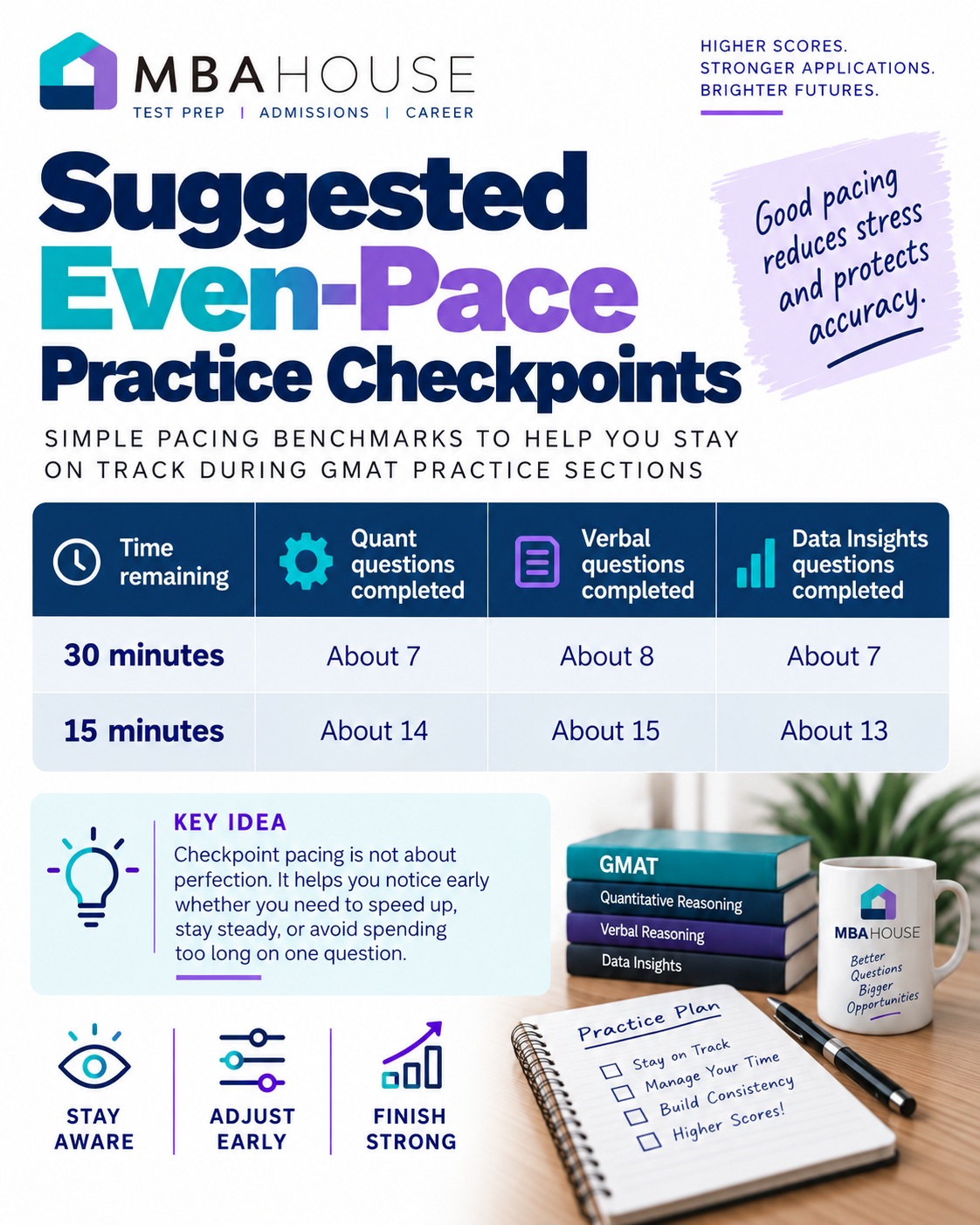
The image below presents suggested even-pace checkpoints. They divide the 45-minute section into three approximate blocks, using rounded question counts. They are MBA House practice suggestions, not official GMAT benchmarks, and they do not reserve time for reviewing answers.
Swipe or scroll the table sideways to see every column.
| Time remaining | Quant questions completed | Verbal questions completed | Data Insights questions completed |
|---|---|---|---|
| 30 minutes | About 7 | About 8 | About 7 |
| 15 minutes | About 14 | About 15 | About 13 |
Read “completed” literally: these are questions for which you have already submitted an initial answer, not the number currently on screen. Mixing up those two quantities can make you think you are farther ahead than you are. Use the same counting convention every time you practice.
At a checkpoint, make a short assessment rather than conducting a full performance review. Are you broadly near your plan? If not, can you identify one recent decision that explains the difference? Then return your attention to the next task. Repeatedly checking the clock without changing your behavior adds distraction without creating a solution.
Being one question away from an approximate checkpoint is a reason to observe, not a command to panic. A longer reading task or an unusually quick solution can create temporary variation. Look for a developing pattern, especially repeated restarts or prolonged indecision, before deciding that your pacing approach needs a major correction.
Recognize progress versus persistence
Productive time changes what you know. You translate a condition into an equation, distinguish the conclusion from its support, eliminate an option, or identify the relevant information in a display. You may still be uncertain, but you can explain what your next step is supposed to accomplish.
Unproductive persistence repeats effort without changing the decision. You reread the same sentence without a specific question, perform the same calculation hoping for a different result, or switch approaches because you feel stuck rather than because you understand what failed. The clock problem begins when you stop noticing that distinction.
Use a brief reset during practice:
- Restate the task: Say what must be found, evaluated, or established.
- Name your progress: Identify what you have actually learned or ruled out.
- Choose a next step: Specify one action that could change your answer decision.
- Decide whether to continue: If no useful next step exists, make the best-supported selection available and move forward.
This is not a universal instruction to abandon difficult questions. It is a way to avoid purchasing more of the same unproductive work. A clear equation with one remaining calculation is different from a page of algebra whose connection to the question you no longer understand.
Before a timed set, decide what “stuck” will look like for you. For example, you might watch for a second full restart with no new information. Afterward, inspect those moments. Was there a skill gap, an overlooked condition, or a reluctance to accept uncertainty? Keep the detailed diagnostic work in your review session, not inside the section clock.
Diagnose timing by section
The same pacing principle applies across sections: invest time where it produces useful reasoning, then stop when the investment is no longer justified. The behaviors that waste time, however, may look different. Use the examples below as observation prompts rather than fixed allowances for every question type.
Quant: make the setup earn its time
Before calculating, identify the requested quantity and the constraints that matter. An efficient-looking calculation is not useful if it answers a different question. A short setup check can be a better use of time than discovering halfway through a long solution that you solved for the wrong variable.
For an illustrative practice problem, suppose you need a ratio rather than the individual values of two quantities. Ask whether their relationship already determines that ratio. Solving separately for both values might be unnecessary. This is a prompt to inspect the task, not a rule that every ratio problem has a shortcut.
If an approach expands into several equations, pause long enough to check its direction. Can you say how the next operation gets you closer to the requested result? If yes, continue deliberately. If not, restarting blindly may deepen the delay. Consider a genuinely different representation only when you can explain why it helps.
When reviewing a timed Quant set, separate time spent choosing a method from time spent executing it. A slow setup suggests a different practice need from repeated arithmetic corrections. Your pacing experiment should address the part that actually consumed the minutes.
Verbal: read with a purpose, not with a speed target
Do not force every Verbal item into the same reading allowance. If you are working with a passage and related questions, some initial reading supports later decisions. Judge that investment across the work it serves rather than treating the first question's time as an isolated failure.
A purposeful first read tracks the argument or passage structure: what is being claimed, how the parts relate, and where important qualifications appear. You do not need to rehearse every sentence internally. When returning to the text, bring a specific question, such as whether a statement applies to all cases or only a limited group.
Between two plausible options, compare the exact point of disagreement. Does one add a condition the text never supplies? Does one describe the author's position more strongly than the passage supports? These are examples of focused checks. Alternating between answers because each “sounds good” is not a resolution method.
If rereading is your main delay, record what you were trying to verify. A return to locate a specific qualification is different from rereading the entire passage because you do not trust your first impression. Practice making the purpose of each return explicit.
Data Insights: orient yourself before working
Start by identifying the task and locating the information relevant to it. In a table, inspect labels and units before combining values. In a graph, establish what the axes represent. When several sources are presented, avoid exploring every detail before you know which information the question requires.
Consider an illustrative display containing both percentages and absolute totals. Comparing percentages alone may not answer a question about the largest numerical change. The timing lesson is not to calculate faster; it is to identify the correct comparison before calculating at all.
For a sufficiency task, distinguish “I could compute this value” from “I have enough information to determine the answer.” Continuing to calculate after the required determination is already possible can consume time without improving the decision. Conversely, an example that works once does not automatically establish that all allowed cases behave the same way.
Review your navigation as well as your reasoning. Did you repeatedly return to the same source because your notes lacked a label? Did you copy irrelevant numbers? Small changes in how you organize the information can be worth testing before you conclude that every question needs a faster calculation.
Recover when you fall behind
The first recovery step is to replace a vague feeling with a concrete budget. Count the unanswered questions and note the remaining time. You do not need precise mental arithmetic during every question; a rough assessment is enough to recognize whether your original plan remains realistic.
For a practice illustration, suppose 15 minutes remain in Quant and you have completed 12 questions. Nine questions remain, so your remaining budget averages about one minute 40 seconds per question. That is tighter than the full-section average. It does not mean every remaining question must take exactly 100 seconds.
Avoid trying to recover everything on the very next question. Instead, remove avoidable behaviors: repeated checking after you have a defensible answer, lengthy attempts with no viable next step, or restarts that simply reproduce the same obstacle. If a question resolves cleanly, accept the result and move forward.
When a question remains unresolved and the available budget is shrinking, make the best-supported selection you can rather than letting indecision consume the entire recovery window. This is a time-allocation choice, not a claim about the scoring value of any particular question. No checkpoint can guarantee that a specific move-on decision improves your score.
If you are ahead, do not automatically spend the surplus. Maintain your normal reasoning checks and preserve flexibility for later tasks. Extra time is useful because it gives you options, not because every minute must immediately be invested in the question in front of you.
After the section, locate where the deficit first developed. The final rush may be the visible symptom, while the original cause was an earlier question you continued long after progress stopped.
Use Question Review & Edit correctly
You can bookmark questions while progressing through a section, but Question Review & Edit becomes available only after you have answered every question in that section and still have time remaining. You may review as many questions as time allows and change up to three answers per section, according to the official GMAT review rules.
Build your strategy around completing an initial answer to every question, not around leaving unfinished work for an imaginary extra period. The review feature does not add time to the section. A bookmark is a reminder to consider returning, not a promise that you will have an opportunity to do so.
During practice, distinguish three reasons for marking a question. You may have a specific calculation to verify, a particular condition to reconsider, or unresolved uncertainty without a clear correction path. If you reach review, start where you can name a concrete action that might resolve the issue.
For example, “check whether I used annual rather than monthly units” is more actionable than “I disliked this problem.” Similarly, identifying a missed qualification is a stronger reason to change an answer than feeling nervous when you see it again. Look for evidence that the original decision should change.
Do not treat the maximum number of answer changes as a target. The permission to change an answer does not establish that changing it is beneficial. In practice, record whether your revisions were supported by new reasoning and whether that reasoning was sound.
Test a review reserve instead of assuming one
The even-pace checkpoints above use the entire 45-minute section. If you want a separate review window, you need a different first-pass budget. Otherwise, you are asking the same minutes to serve two purposes.
For an illustrative experiment, reserving three minutes leaves 42 minutes for the initial pass. Dividing that budget gives averages of two minutes for each Quant question, about one minute 50 seconds for each Verbal question, and two minutes six seconds for each Data Insights question. These are calculated practice budgets, not official recommendations.
A review reserve is useful only if the tradeoff works for your performance. Finishing sooner is not automatically better if you create avoidable errors by rushing the first pass. Likewise, an attractive plan on paper has little value if you never reach the review screen with usable time.
Compare a small number of realistic practice attempts rather than changing your strategy after every uncomfortable question. Observe completion, first-pass reasoning quality, and whether your remaining minutes produced specific corrections. Keep the reserve modest enough to test honestly, and do not infer a universal best allocation from one successful section.
If your first pass is currently unstable, focus first on eliminating repeated stalls. You can experiment with a separate review allowance once you can finish without repeatedly sacrificing the last portion of the section.
Rehearse section order and the break
The GMAT allows the sections to be taken in any order and offers one optional 10-minute break after the first or second section. These options are described in the official exam structure.
There is no need to declare your strongest section the universally correct starting point. Instead, compare how a chosen order works for you under realistic practice conditions. Can you begin steadily? Does your clock awareness remain usable in the last section? Does your planned break placement support a calm return to work?
Try to keep other conditions reasonably consistent when comparing orders. If one attempt follows adequate rest and another follows an exhausting workday, the order alone cannot explain the difference. Treat your observations as individual planning evidence, not a scientific verdict from a tiny sample.
Rehearse the transition back into a section as deliberately as the section itself. Settle your attention on the new task rather than mentally replaying a previous answer. Once the next section begins, the useful decision is how to allocate its time, not how to rewrite the section you have already completed.
Build a pacing strategy you can repeat
Practice the decision process in manageable stages. First, use a timed set to observe your habits without demanding that every question meet an identical limit. Note where you restarted, where you checked repeatedly, and where you had a clear reason to continue. Then test a specific change in another set.
Next, take the approach into a complete section. Short sets can help you rehearse a move-on decision, but they do not show how that decision interacts with an entire section budget. Pay attention to the last part of the section: did your earlier choices leave you enough room to read and reason, or merely enough room to select answers?
Finally, rehearse across a full practice exam. Keep your clock-checking routine simple enough to remember under pressure. A useful plan might be: check at the two broad milestones, notice prolonged unproductive work, and reassess the remaining budget when a meaningful delay develops.
Change one major behavior at a time where possible. For example, test a more deliberate move-on decision before simultaneously changing section order, reading style, and review allowance. Otherwise, even an encouraging result may not tell you which adjustment helped.
Write your final pacing routine in a few sentences before the next simulation. Include when you will check the clock, how you will recognize a stalled approach, and what you will prioritize if review becomes available. If the routine is too complicated to recall, simplify it before testing again.
This article addresses time allocation inside the exam. For fitting preparation around your job, use the GMAT study plan while working full time. If better pacing still leaves your results stuck, the GMAT score-not-improving guide explains how to investigate the underlying mistakes rather than simply adding more timed questions.
Common GMAT timing questions
Should I spend exactly two minutes on each question?
No. Use averages to understand the section budget, not to impose identical limits on different tasks. A better practice question is whether a longer investment is producing progress and whether it still fits the time available for the remaining work.
Should I rush the beginning to create a cushion?
Do not create a cushion by abandoning your normal reasoning checks. Aim for a controlled opening instead: understand the task, choose a defensible method, and avoid unnecessary rechecking. A surplus created by clean solutions is different from one created by careless speed.
What if I keep finishing with no review time?
First ask whether you completed the section with a workable first-pass process. Then inspect where minutes were lost and test a modest adjustment. Do not assume that access to review is more valuable than a careful initial answer; evaluate what your proposed tradeoff actually changes.
What should I bring to a timing consultation?
Bring a recent timed practice result, your approximate checkpoint positions, and two or three examples of decisions that consumed more time than expected. Explain what you tried, when progress stopped, and what you did next. That is more useful than saying only that you need to become faster.
For help turning those observations into a personal pacing approach, talk with MBA House about your GMAT preparation. You can also explore our GMAT classes and tutoring to see how guided practice might fit your needs. The aim is a plan you can execute consistently, not a timing trick or a guaranteed score increase.