

This guide gives you a seven-hour sample week, a way to organize a longer preparation period, and rules for adjusting the calendar when work intervenes. The schedule is a planning example, not a promise that seven hours a week or any fixed number of weeks will produce your target score.
The goal is not to complete the largest possible question bank. It is to make your available hours useful, maintain a clear next step, and decide when your plan needs to change.
Define the outcome before filling the calendar
Start with three decisions: which application deadlines matter, what evidence you need about your current skills, and how much study time you can protect without borrowing from essential responsibilities. Write those decisions down before choosing daily assignments.
Separate your preferred test date from your preparation requirements. A date can organize the work, but it does not make a large skill gap disappear. If your starting point and available hours do not support your timeline, change the timeline or the resources available rather than pretending the conflict does not exist.
Your planning sheet should contain a target test window, weekly availability, known work disruptions, and a date for reviewing the plan. Keep admissions deadlines separate from study milestones so you can see how they interact.
For example, “study more before applications” is difficult to schedule. “Protect four weekday sessions and two weekend blocks, then reassess after two weeks” gives you something concrete to execute and evaluate.
Audit your real study time
Build your first calendar from a recent, ordinary workweek rather than an unusually quiet one. Identify when you had enough attention for demanding work, when you could manage a short review, and when studying would have been unrealistic.
Distinguish focused study from useful but lighter preparation. Solving unfamiliar questions and analyzing your decisions require a different kind of attention from organizing notes or watching part of a lesson. Both can belong in the plan, but they are not interchangeable.
Try labeling potential study blocks by what you could actually do in them:
- Focused block: A protected period for unfamiliar questions, concept work, or a timed exercise.
- Review block: A shorter session for revisiting work you have already attempted.
- Flexible block: Optional time that may disappear when work becomes demanding.
Build the essential plan from focused and review blocks. Treat flexible time as a bonus, not the condition that makes your entire schedule work.
Keep a small buffer for unexpected commitments, and decide which optional task you will drop before sacrificing essential review time.
If evenings repeatedly fail, test a morning session or a quieter weekend arrangement. Choose the schedule you can repeat, not the one that looks most disciplined on paper.
Start with a baseline, not an ambitious calendar
Before assigning several weeks of topics, take a diagnostic appropriate to the current exam. Record whether you were interrupted, recognized questions, or changed the conditions midway through the attempt.
The current GMAT contains Quantitative Reasoning, Verbal Reasoning, and Data Insights, with 45 minutes allocated to each section. Your baseline should therefore examine all three rather than treating preparation as a math-only project. (Official GMAT exam structure)
For planning purposes, turn the result into a short priority list. Choose one main skill to rebuild, one secondary area to maintain, and one question you need to investigate about your approach.
Avoid filling the next month with every weakness you can identify. A list of twenty priorities does not tell you what to do on Tuesday evening. Choose a manageable starting point, then revise it when practice provides more evidence.
If you need help understanding what a baseline should reveal, read the GMAT diagnostic guide. This study-plan article focuses on scheduling the work that follows, rather than replacing a diagnostic assessment.
A sample GMAT study plan for a busy week
The following schedule totals 420 minutes, or seven hours. It includes practice, review, and weekly planning rather than treating review as extra work you must somehow fit around the assignments.
Use it as a template, not a fixed prescription. A candidate rebuilding several foundations may need a different workload and timeline from someone returning to preparation with a narrow set of priorities.
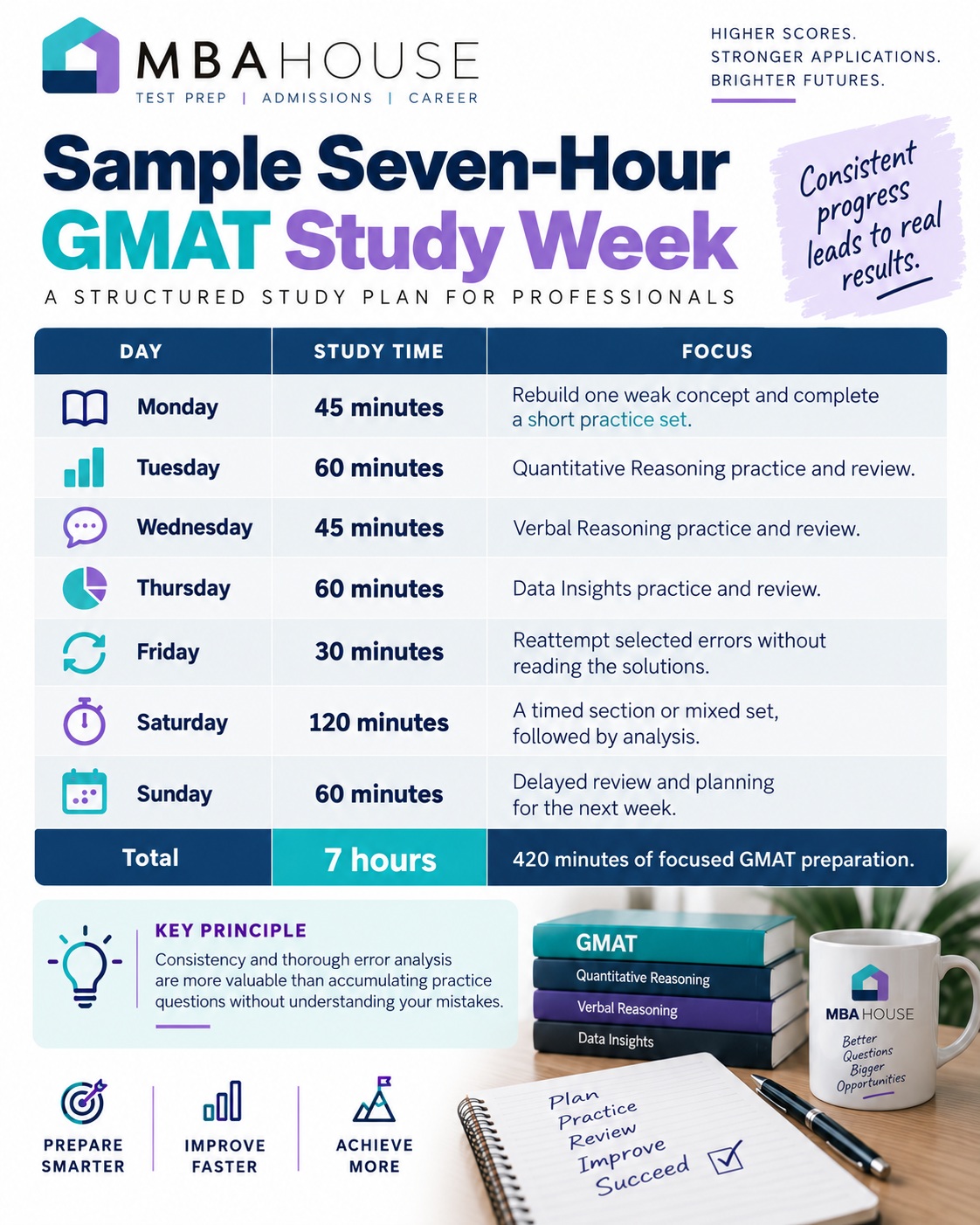
| Day | Time | Focus |
|---|---|---|
| Monday | 45 minutes | Rebuild one weak concept and complete a short practice set |
| Tuesday | 60 minutes | Quantitative Reasoning practice and review |
| Wednesday | 45 minutes | Verbal Reasoning practice and review |
| Thursday | 60 minutes | Data Insights practice and review |
| Friday | 30 minutes | Reattempt selected errors without reading the solutions |
| Saturday | 120 minutes | A timed section or mixed set, followed by analysis |
| Sunday | 60 minutes | Delayed review and planning for the next week |
| Total | 420 minutes | Seven hours of planned preparation |
Move the days if your work pattern demands it. The important feature is the sequence: identify a priority, practice it, revisit it, and use the results to plan the next cycle.
This is a self-study allocation, not MBA House’s live class timetable. If a class or tutoring session replaces a block, update the duration and weekly total rather than assuming both activities fit into the original seven hours.
Monday: choose one manageable priority
Use Monday’s 45 minutes to begin with a clearly defined task. “Improve Quant” is too broad; “rebuild the relationship between a ratio and the quantities it describes” is a workable assignment.
A possible split is ten minutes of concept review, twenty minutes of practice, and fifteen minutes explaining what happened. Adjust the split to the task instead of stopping a useful explanation merely because a timer reaches an arbitrary checkpoint.
End by writing the next action. That could be a follow-up question, a concept to clarify with a tutor, or a different example to try later.
Tuesday: connect practice with explanation
Use the sixty-minute Quant block to attempt a small set and examine your methods. Select a workload that leaves room for review instead of spending the full session collecting answer choices.
For each question you review, explain the setup before checking the solution. If you understand an explanation only after seeing it, record what prevented you from finding that starting point independently.
The session is complete when you know what to carry forward, not simply when you have finished a predetermined number of questions.
Wednesday: protect Verbal from being postponed
Make Wednesday’s forty-five minutes a deliberate Verbal assignment. Define the task before opening the material, such as identifying the conclusion of an argument or explaining the role of a paragraph.
Reserve time to compare your reasoning with the evidence in the text. A short session with an explicit task is easier to review afterward than an unstructured sequence of questions.
If Wednesday becomes unavailable, move this block deliberately. Do not let the section disappear from the week because another subject feels more urgent.
Thursday: give Data Insights its own place
Use Thursday’s sixty-minute block for Data Insights rather than assuming that other study will automatically cover every need. Choose material connected to the priorities you identified in your baseline or recent work.
Write down the task the question requires before calculating. During review, distinguish understanding the information from deciding what information was actually necessary.
Keep this session narrow enough to finish thoughtfully. If a question exposes a larger gap, schedule the underlying work rather than turning the evening into an unplanned marathon.
Friday: revisit without the solution
Use Friday’s thirty minutes to return to selected work from earlier in the week. Hide the explanation and see whether you can reconstruct the method in your own words.
Label remembered answers honestly. Recognizing an answer from Tuesday is not the same as demonstrating that you can solve an unfamiliar question with the same structure.
Where possible, include a different example requiring the same decision. Keep the block short enough that it remains feasible at the end of a demanding workweek.
Saturday: use the longer block intentionally
Use the two-hour Saturday block for a timed section or mixed set followed by analysis. Decide what you want to learn from the session before you begin.
This block is not long enough for a complete standard GMAT practice exam plus review: the current exam itself lasts two hours and fifteen minutes, excluding its optional ten-minute break. Schedule a separate, longer window when a full simulation is appropriate. (Official GMAT exam structure)
For detailed section checkpoints and pacing decisions, use the separate GMAT timing strategy guide. Keep this calendar focused on when that practice happens.
Sunday: close the loop
Use Sunday’s hour to revisit selected work and decide the next week’s assignments. Compare the planned schedule with what you actually completed before increasing the workload.
Choose one priority to continue, one task to change, and any questions that require outside help. Place those decisions directly into the calendar while they are still clear.
Leave the next session ready to start. Knowing the material, task, and purpose in advance removes one more decision from a busy Monday.
Turn the weekly template into a longer plan
A longer plan should describe stages of work, not promise that every candidate will become ready in the same number of weeks. The twelve-week example below is a planning framework you can shorten, extend, or reorganize after reviewing your starting point.
Do not confuse a twelve-week self-study framework with a particular course length. Your course schedule, independent practice, application timeline, and readiness checks may overlap without following the same calendar.
Opening stage: establish the routine
During the first two weeks, learn whether the proposed schedule is realistic. Complete your baseline, organize your materials, and identify which study blocks survive an ordinary workweek.
Measure execution before adding complexity. Did you complete the planned review? Were the evening sessions genuinely focused? Did an unrealistic Saturday assignment push unfinished work into Sunday?
Use the answers to revise the next fortnight. A smaller schedule that you execute consistently gives you clearer evidence than a larger schedule that exists mainly on paper.
Middle stage: build and connect skills
For the next several weeks, assign focused work according to your priority list while keeping all sections present. Revisit earlier material instead of allowing each new topic to replace everything that came before it.
Begin combining skills once you can explain the individual methods. Keep enough review time to understand whether a mistake comes from the concept itself or from recognizing when to apply it.
At a planned checkpoint, reassess the workload and timeline. Extend this stage if the foundations remain uncertain rather than advancing merely because the calendar says you should.
Later stage: test the plan under realistic conditions
In the later weeks, reserve suitable blocks for broader timed practice and full simulations when useful. Arrange the environment beforehand so you are not negotiating interruptions after the session begins.
Use the results to decide what deserves the remaining study time. Preserve targeted work between assessments rather than filling the calendar exclusively with practice exams.
Your final planning decision is whether the evidence supports the test window you chose. If it does not, review your options before an approaching deadline becomes the only reason to proceed.
Adapt the schedule when work changes
A working professional’s calendar needs a fallback version. Write it before a demanding week arrives, when you can still make deliberate choices instead of reacting to missed sessions.
For a short disruption, preserve a few essential review blocks and one focused assignment. This reduced week is a temporary continuity plan, not a claim that minimal study is enough for your long-term goal.
If disruption becomes the normal pattern, rebuild the baseline schedule. Repeatedly planning seven hours and completing three tells you something about capacity; it is not a reason to keep copying the same calendar.
When one evening disappears
Move the task only if another realistic block exists. Otherwise, reduce that week’s new material and keep the highest-priority review rather than doubling the next evening automatically.
Record the change so your later evaluation is fair. You should not judge a revised five-hour week as though you completed the original seven-hour plan.
When travel interrupts several days
Choose tasks that fit the attention and environment you expect to have. A short review may be feasible during travel, while an uninterrupted timed assessment may not be.
Schedule the demanding assessment for a more suitable setting. If travel is a recurring feature of your job, the consultant-focused preparation guide discusses that service context separately.
When the deadline is becoming unrealistic
Review your readiness evidence, remaining commitments, and application options together. Avoid treating extra late-night hours as the only available response.
Discuss the trade-off with an advisor if you need help. The appropriate decision depends on your circumstances, not on a universal rule that everyone should keep or postpone a test date.
Fit classes and tutoring into the same calendar
Treat instruction as part of the workload rather than something outside it. Record the class duration, preparation required, and follow-up review in the same place as your independent practice.
MBA House offers live GMAT classes on Tuesday and Thursday at 7:30 PM ET, in NYC or online; Tuesday rotates Math or Verbal, and Thursday rotates Math or Data Insights, with one subject per session. Check the GMAT course schedule for the current delivery details.
If you attend a ninety-minute class instead of the sample week’s sixty-minute block, the total changes unless you deliberately adjust another session. Preserve room afterward to identify what you understood and what needs further attention.
Before a tutoring session, choose a specific question about your work. Bring the attempted solution, explain where you became uncertain, and decide what follow-up practice will test the advice you receive.
For candidates comparing enrollment options, use the course page rather than this sample calendar as the source of program details. The calendar shows how to organize preparation; it does not define what a particular package includes.
Keep your planning tools simple
You do not need several overlapping systems to manage the week. Start with one calendar, one list of current priorities, and one place to record questions or corrections that must return to the schedule.
Give each session a task and a finish condition. “Review mistakes” is vague; “reattempt three selected questions, explain the setup, and identify the next step” tells you when the block has achieved its purpose.
If your score is already stuck and you need a deeper diagnosis, use the GMAT score-plateau guide. It covers the error log and reasoning analysis without making this planning page repeat those tools.
Choose materials before the week starts and avoid changing resources merely because one session feels difficult. Change the resource when you can identify what it is failing to provide.
Adjust the plan using evidence
Review three things each week: what you completed, what you can now explain, and what still requires help. Keep the evaluation specific enough to change the next calendar.
Time spent is useful context, but it is not the only measure. If you completed every scheduled hour while avoiding the task you most needed to practice, the schedule was followed without necessarily addressing the priority.
Conversely, a disrupted week can still produce a useful discovery. Record that discovery and decide how to test it, rather than measuring the week only by missing hours.
Keep score interpretation separate from scheduling. Use the GMAT score chart and calculator when you need to understand the score scale; use your work and availability to decide the next assignments.
Questions about studying while working
Is seven hours a week enough?
It depends on your starting point, target, study quality, and available timeline. Seven hours is the workload in this example, not a recommended minimum or a guarantee of readiness.
Try a realistic schedule, collect evidence, and reassess. If the work exposes substantial gaps, you may need more time, a longer preparation period, or more targeted support.
Can I study mainly on weekends?
You can arrange a weekend-heavy plan if that is when focused time is available. Include short weekday review sessions where possible so the next weekend does not begin with reconstructing everything you did previously.
Protect the weekend blocks in advance. A calendar that assumes every Saturday remains free is vulnerable if that assumption is rarely true.
Should I study every section every day?
You do not need to divide every session among all three sections. The sample week assigns a main focus to each block while keeping all sections represented across the week.
Change the balance based on evidence without abandoning a section indefinitely. A current strength still deserves periodic attention.
How often should I take a full practice exam?
Schedule one when you have a clear assessment question and sufficient time to review the result. Do not add an exam solely because another week has passed.
Reserve a separate, uninterrupted block for the attempt and another block for analysis if necessary. Avoid squeezing a full assessment into the sample Saturday window.
What should I prepare before asking for help?
Bring your latest practice results, a sample of your actual working, your preferred test window, and a candid account of your weekly availability. Include the commitments that repeatedly disrupt preparation.
Those details make it easier to discuss a useful plan than a target score alone. You do not need a perfect spreadsheet before starting the conversation.
Build a plan around your actual workweek
Start with the week you can genuinely protect. Choose the first priority, put practice and review into the same calendar, and set a date to reconsider the plan.
The image and schedule above are starting tools, not rules you must obey. Adapt them deliberately and use the evidence from completed work to decide what happens next.
Contact MBA House about your GMAT study plan. Tell us your work schedule, target programs, and where preparation is getting stuck so we can discuss the next step.