

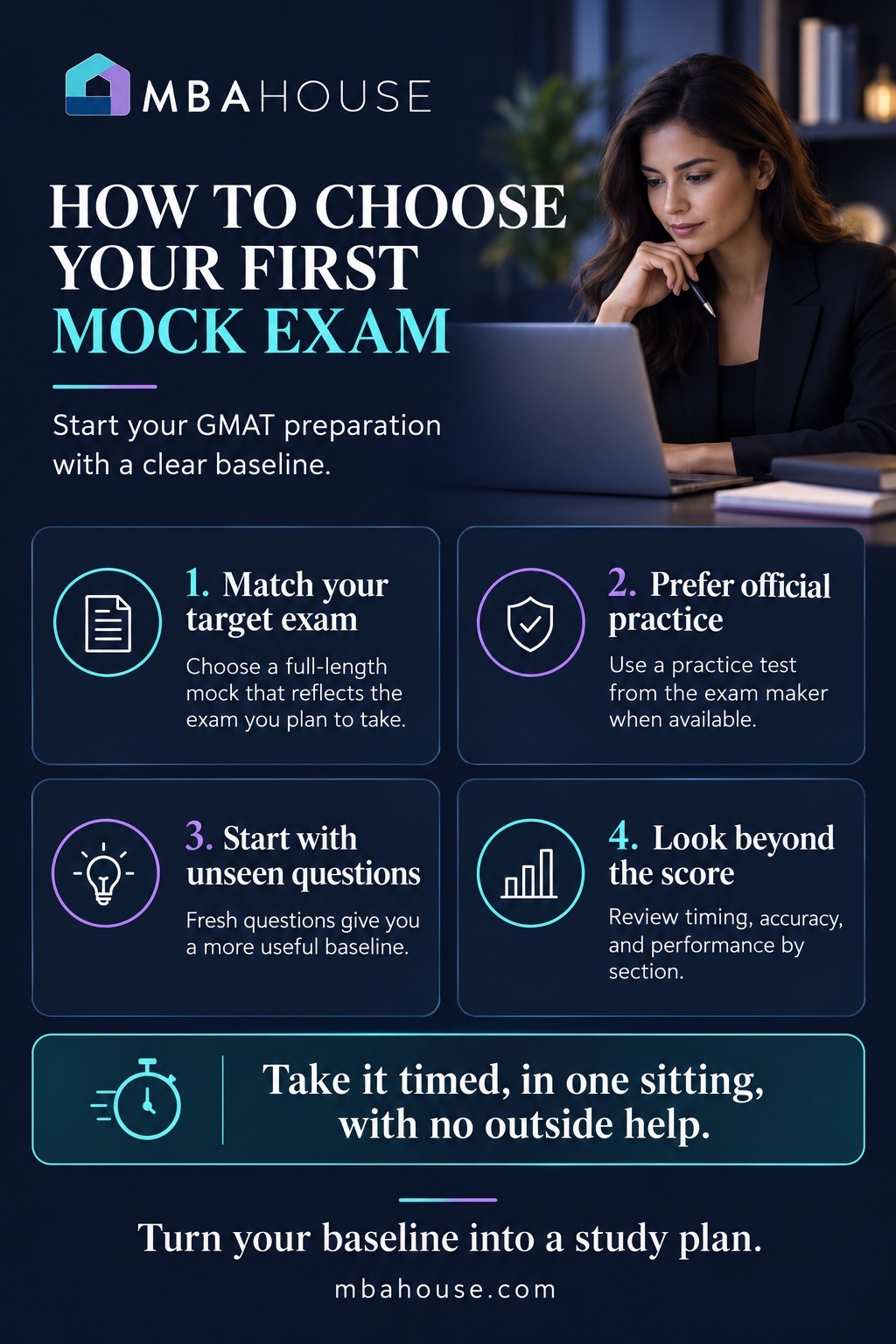
Our recommendation: After you have learned the question formats and interface, use an unused GMAT Official Practice Exam for your first full-length baseline. GMAC provides Practice Exams 1 and 2 free and states that its official practice exams use the same algorithm, scoring, and timing as the real exam (official GMAT preparation resources).
Use other resources when they solve a specific learning need. A question bank can support focused practice, and a short quiz can introduce unfamiliar questions, but neither should be presented as equivalent to a full-length mock exam.
Your first GMAT practice test should help you make a decision, not simply produce a number. Before you open a mock exam, decide whether you want to become familiar with the interface, establish a baseline, or rehearse the full testing experience. That purpose determines which resource is useful and what you can reasonably conclude from the attempt.
This guide helps you choose the resource and set up a meaningful first attempt. If the exam itself is new to you, start with our GMAT exam format and requirements guide, then return here to select your first mock.
Choose the resource for the job
For planning purposes, we distinguish three activities: learning a skill, measuring performance across an exam, and interpreting what the result means. A single product may support more than one activity, but the activities are not interchangeable. The table below is an MBA House decision aid, not a rating of individual providers.
On a small screen, scroll the table sideways to read every column.
| Your immediate need | Resource to consider | Do not assume |
|---|---|---|
| Understand an unfamiliar question format | Official sample questions or a guided introductory set | A few answers predict your total score |
| Practice one skill with feedback | A topic-based question bank with explanations | Untimed accuracy equals full-exam readiness |
| Establish a full-length baseline | An unused official practice exam under realistic conditions | One result guarantees your eventual exam score |
| Understand the causes behind a result | A diagnostic review of the attempt and your working | The total score alone explains what to study |
| Rehearse the complete testing experience | A current-format full-length simulation | A sectional drill reproduces the whole experience |
Use GMAC's sample questions to see the official formats. If your immediate need is interpretation rather than resource selection, our GMAT diagnostic guide explains how to turn an attempt into a discussion about your preparation priorities.
Why start with an official GMAT practice exam?
The key distinction is the relationship to the real test, not whether the product page looks polished. GMAC states that Official Practice Exam 1 uses the same format and scoring algorithm as the real exam, and that all its official practice exams use the same algorithm, scoring, and timing (GMAC preparation guidance).
For a first full-length baseline, that makes an official exam our recommended reference point. You are reducing uncertainty about the simulation while you learn about your own performance. It does not mean a mock result is a promise of a particular official score, or that one test tells the whole story.
The free Official Starter Kit includes Practice Exams 1 and 2, along with a guided sample of 70 questions (official Starter Kit details). Start at mba.com and follow its official access instructions rather than assuming a website with “official” in its name is operated by GMAC.
Our suggested sequence is straightforward: become familiar with representative questions, learn the platform controls, and then take an unused official mock when you can complete it without avoidable interruptions. GMAC also recommends using its first official practice exam to establish a baseline (official preparation sequence).
When can third-party practice be useful?
Consider a third-party resource when you can name the additional job it needs to do. You might want more explanation of a particular reasoning method, focused practice in one format, or another opportunity to use a timed interface. Evaluate those features directly rather than treating a high or low mock score as proof of product quality.
Do not assume that every commercial practice exam uses GMAC's scoring algorithm. Ask the provider what its score represents, how the test adapts, and what evidence supports any accuracy claim. If the provider does not explain its methodology, treat that uncertainty as part of your purchasing decision rather than filling in the answer yourself.
A resource can be helpful for learning without being your preferred score benchmark. For example, you may find a provider's explanations useful while continuing to use unused official exams as your reference for full-length assessment. That is a clearer division of roles than averaging unrelated scores from several products.
This article does not rank commercial providers or claim to have tested products we have not reviewed. The checklist below gives you questions to ask before committing money or a full study session.
The MBA House mock-exam comparison checklist
Open the product description, sample interface, and help pages before you choose. Record whether each feature is confirmed, unclear, or absent; a vague marketing statement is not the same as a documented capability. Prioritize the checks that matter to your purpose instead of adding up ticks into an invented “accuracy score.”
| Check | What to verify | Why it matters |
|---|---|---|
| Current-format coverage | All current sections and question types, rather than a retired exam structure | A baseline should assess the exam you intend to take |
| Full-length or partial | Whether the resource is a complete exam, section test, or short quiz | The label “practice test” alone does not define the task |
| Adaptive behavior | Whether questions adapt and how the provider describes that process | Separate a fixed question set from an adaptive simulation |
| Scoring transparency | Who produces the score and what any predictive claim is based on | Do not confuse a provider estimate with an official result |
| Interface and tools | Section order, review controls, calculator access, and timer behavior | Check the experience you will actually rehearse |
| Explanation access | Which answers receive explanations and when you can see them | Plan how you will learn from the attempt |
| Question exposure | Whether you have already seen the questions and what resets change | Distinguish fresh reasoning from recognition |
| Access conditions | Expiration, device requirements, attempts, reset limits, and current terms | Make sure the resource fits the way you intend to use it |
For a current-format check, the GMAT has Quantitative Reasoning, Verbal Reasoning, and Data Insights, with 64 questions across three 45-minute sections. Total testing time is 2 hours and 15 minutes, with one optional 10-minute break (official GMAT structure). Compare a mock against the official specification, not against the year printed on its cover alone.
Also check the controls rather than only the question count. The real exam allows Question Review & Edit after every question in a section has been answered, if time remains, with up to three answer changes in that section (official review rules). Quantitative Reasoning does not allow a calculator; Data Insights provides an on-screen calculator (official calculator rules).
Set up your first mock before starting the clock
Decide in advance whether this attempt is a learning walkthrough or a baseline. Either can be useful, but giving yourself explanations, extra breaks, or unlimited time changes the question you are answering. If you deliberately change the conditions, write that down and use the attempt for its intended purpose.
- Confirm the exact resource. Record its provider, exam number or version, and whether this is your first exposure to its questions.
- Learn the controls first. Use instructions or samples to understand how to submit answers, bookmark questions, and navigate permitted review.
- Reserve an uninterrupted window. Allow for the full exam, the permitted break, and setup. Do not squeeze a full simulation into a short gap between commitments.
- Check your equipment. Confirm the resource works on your device and browser before the planned start. Recheck the official permitted tools for the delivery format you intend to use.
- Remove avoidable assistance. For a baseline, put away solution tabs, answer searches, and messaging. Do not switch between the test and a worked-solution page.
- Record exceptions afterward. Note interruptions, extra time, technical problems, or recognized questions so that you do not later forget how the result was obtained.
GMAC recommends test-day-like conditions for its official practice exams, including a quiet space and the tools permitted on test day (official simulation advice). For specific checkpoint and move-on decisions, use our GMAT timing strategy; those decisions belong in a pacing plan, not in the choice of mock provider.
If arranging the uninterrupted window is the difficult part, use our GMAT study plan while working full time. Keep resource selection separate from calendar design: the right mock still needs a realistic place in your week.
Two examples of choosing the right resource
The examples below are hypothetical decision cases, not student testimonials or reported outcomes. They illustrate why two applicants can reasonably choose different activities without one applicant being more serious about preparation.
A first-time applicant who has never seen Data Insights
Suppose an applicant wants a baseline but does not yet know how a table-based question is answered. We would recommend a brief introduction through official samples before the full mock. The purpose is to understand the task and controls, not to postpone assessment until every topic feels comfortable.
Once the formats are familiar, an unused official practice exam becomes the next step. The applicant can then distinguish uncertainty about reasoning from uncertainty about what the screen was asking them to do.
An applicant who remembers many questions from an old attempt
Suppose another applicant resets a mock and recognizes several questions. We would classify that attempt as practice with previously seen material rather than treat it as a fresh benchmark. It can still be useful for explaining a method or checking execution, but the interpretation should reflect the exposure.
If the decision is whether to book an official exam, our recommendation is to seek evidence from unused material under comparable conditions. Do not turn a remembered answer into a claim about readiness on unfamiliar questions.
What to do with the result
Save the practice report using the options provided by that platform and record the conditions of the attempt. Keep the provider name and exam version with the result. This prevents a learning walkthrough, a repeated mock, and a clean first attempt from becoming three apparently equivalent numbers in your notes.
For a score lookup, use our GMAT score chart and percentile guide. Keep the distinction clear: a practice score is not an official result, and interpreting its numerical scale does not establish the predictive accuracy of the practice product.
For the next learning decision, ask what evidence you need rather than automatically opening another full test. If repeated attempts are not translating into progress, our GMAT score-plateau guide covers error analysis and correction. If you need help interpreting the baseline, bring the report and your notes to a conversation with MBA House.
Questions about your first GMAT practice test
Which GMAT practice test should I take first?
Our recommendation is an unused GMAT Official Practice Exam after you have learned the formats and controls. GMAC specifically recommends its free Official Practice Exam 1 to establish a baseline (official preparation guidance).
Are there free official GMAT practice tests?
Yes. GMAC's free Official Starter Kit includes Practice Exams 1 and 2, which are full-length practice exams (official Starter Kit). Use mba.com to find the official access instructions.
Is a question bank the same as a mock exam?
In this guide, a question bank means a collection used for practice, while a full-length mock means a complete exam simulation. Check the product's actual modes and specifications, since the name alone does not tell you which experience it provides.
Can I pause my first practice test?
Follow the platform's rules, and decide whether you are doing a walkthrough or a realistic simulation. Our recommendation for a baseline is not to add breaks or time beyond the intended exam conditions; if an interruption is unavoidable, record it and interpret the attempt accordingly.
Should I buy third-party mocks before using the free official exams?
Our recommendation is to start with the official free resources and identify an unmet need before buying more. A paid resource should add something you can name, such as targeted practice or explanations, rather than simply add another score to your notes.
Should I repeat the same mock exam?
You can use previously seen material for learning when the platform permits it, but we would not treat a recognized-question attempt as a fresh baseline. Check reset terms before relying on another attempt, and record your previous exposure.
Choose one useful next step
If you are starting today, open the official sample questions, learn the interface, and choose a realistic window for an unused official mock. If you already have a practice report, the next step may be interpretation rather than another purchase.
Book a free evaluation with MBA House to discuss your starting point, target programs, and the kind of support you need. You can also explore our GMAT classes and tutoring before deciding whether guided preparation fits your goals.